AI-Powered Payroll Software: How Tax Advisors Will Save Time in 2026
Jan 13, 2026
AI payroll accounting for tax consultants: Learn how project b. reduces manual work by 80% with RITA and helps combat the skilled labor shortage.
Ready for payroll that finally takes the pressure off?
Leave your contact details - we will get back to you shortly.
Monday morning, 7:43 a.m. Your inbox shows 47 unread emails. The payroll week has begun.
You open the first email: an Excel list of overtime, but without employee numbers. The second: a scan of a sick note, poorly photographed, barely legible. The third: "Attached are the changes" – without an attachment.
Somewhere between email 23 and 24, the phone rings. A client asks if their data has arrived. You scroll frantically through the inbox. "I will get back to you."
By Thursday, all invoices must be complete. You know: the next four days will be long again. Lunch breaks? Short. End of the workday? Late. Nerves? Frayed.
This doesn’t have to be the case in 2026.
Modern payroll software with artificial intelligence is changing the rules of the game. Not through empty promises, but through concrete relief in exactly those tasks that currently consume the most time: data entry, queries, formatting.
In this article, you will learn how AI-driven payroll software helps accountants handle more clients – without hiring more staff. And why the payroll week might not have to be the most stressful part of your month soon.
The Problem: Why traditional payroll software is no longer sufficient
German payroll processing is among the most complex in the world. Collective agreements, social security, minimum wage, sector-specific regulations – the expertise required is enormous.
But the real problem lies elsewhere.
The time waster is not the payroll itself
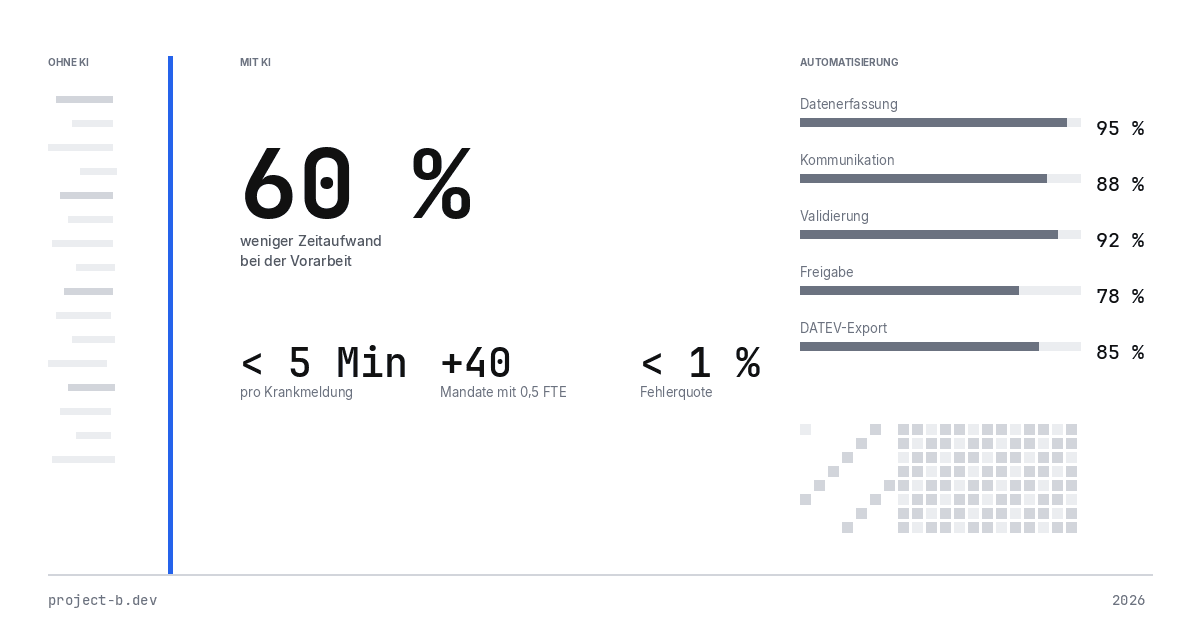
According to a DIHK study, payroll accountants spend up to 60% of their working time on preparatory tasks:
Extracting data from emails, PDFs, and Excel lists
Asking clients for clarifications and waiting for responses
Manually entering information into the payroll system
Correcting errors that arise from media breaks
The actual payroll in DATEV? That works. But it takes hours for the data to arrive there.
A typical day in the payroll week
Imagine: You handle 15 clients with a total of 400 employees. Client A sends structured Excel sheets – exemplary. Client B photographs handwritten timesheets. Client C responds to your inquiry from last week with "See attached," but the attachment is a WhatsApp forward from their site manager.
Each client has a different process. Data needs to be entered individually for each employee. And in between: phone calls because someone can’t find their payslip.
This is not payroll processing. This is data logistics.
And herein lies the problem: You were not trained to just type in data. You were trained to process payroll, to consult, to solve complex cases. But there is no time for that work.
The shortage of skilled workers exacerbates everything
Open positions remain unfilled for months. Experienced colleagues retire. New employees need to be trained – by colleagues who themselves have no time.
A recent study shows: 73% of firms have difficulty finding qualified payroll accountants. The result? Overtime for everyone. Or refusals of mandates.
The outcome: Every new client means proportionally more staff. Growth becomes a burden instead of an opportunity. And the question "Can we actually take on this client?" is asked more often than "Do we want to?".
What AI-driven payroll software really can do
Artificial intelligence in payroll processing does not mean that an algorithm takes over your job. It means that you have a digital assistant who does the preparatory work.
The three core capabilities
1. Automatic data extraction
No matter if PDF, Excel, email, or scan – modern AI recognizes payroll-relevant information and structures it uniformly. No more manual data entry.
2. Intelligent plausibility check
The AI detects discrepancies: Is any information missing? Is a value implausible? Does anything contradict the Master Data? You can immediately see where clarification is needed.
3. Structured communication
Instead of writing dozens of individual emails, a cockpit shows all open points per client. Queries are bundled, and responses are automatically assigned.
How AI “thinks” – a look behind the scenes
When a sick note comes in as a photo, the following happens in milliseconds:
Document recognition: The AI identifies the document type – sick note, not a leave request
Text recognition (OCR): Even skewed, blurry scans become readable
Data extraction: Name, time period, diagnosis code are recognized
Assignment: Matching with master data – which employee, which client?
Plausibility check: Is the employee even still employed? Are there overlaps with vacation?
Preparation: Everything is structured in the cockpit, ready for approval
All of this happens before you finish your coffee.
What AI cannot do – and should not
Let’s be honest: AI does not replace expert knowledge.
The final check remains with humans
Complex exceptional cases require your expertise
The responsibility for payroll lies with you
This is not a bug; it is a feature. Because that is where your value lies: in the qualified assessment, not in data entry.
The AI is your assistant, not your replacement. It prepares things; you decide.
project b.: AI pre-system for payroll processing
project b. is not another payroll software. It is a pre-system that integrates seamlessly into your existing DATEV infrastructure.
RITA: Your AI Assistant
RITA is project b.'s AI. She reads incoming documents, extracts relevant data, and prepares everything for processing.
Practical example 1: The sick note
A client sends a sick note as a photo via email.
Without RITA: You open the email, download the image, read the data, open DATEV, search for the employee, enter the data, save. Time required: 15-30 minutes.
With RITA: RITA recognizes the document, extracts name, time period, and diagnosis, assigns it to the employee, and displays it in the cockpit for approval. Your task: Check, click, done. Time required: under 5 minutes.
Practical example 2: New employee at the client
Your client hires someone and sends you the documents – personnel questionnaire as PDF, social security verification as a scan, tax ID via email text.
Without RITA: You gather everything, manually enter it into DATEV, ask for missing information, wait for a response, enter it later. Time required: 45-60 minutes.
With RITA: All documents are automatically recorded, data extracted, and assigned to a new employee profile. RITA highlights missing mandatory fields. You send a bundled inquiry. After the response: Approval with one click. Time required: 15 minutes.
The cockpit: Everything at a glance
No more tool-switching. In the project b. cockpit, you see:
Status of all clients in the payroll week
Open inquiries and missing data
Approved changes, ready for DATEV export
Document history and communication log
The cockpit is your command center. Instead of working in five different windows, you have everything in one place. Traffic light colors immediately show: Where is everything running well, where is it stuck?
DATEV integration: Pre-system, not replacement
project b. does not replace DATEV. The data flows through project b., is structured and checked – and then cleanly goes into the payroll system.
This means:
No migration necessary
Your usual DATEV workflows remain
Approved data flows automatically
A day with vs. without project b.
Scenario: Tuesday of the payroll week, 10 clients, 250 employees
Without project b.
Time | Activity |
|---|---|
8:00 | Sort emails, download attachments |
9:30 | Enter first data manually |
11:00 | Formulate and send inquiries |
12:00 | Short lunch break |
12:30 | Transfer more data, wait for responses |
15:00 | Integrate responses, create new inquiries |
17:30 | 3 clients left, continue tomorrow |
18:30 | End of the workday with a guilty conscience |
With project b.
Time | Activity |
|---|---|
8:00 | Open cockpit – RITA has processed all entries |
8:30 | Plausibility check, 12 points to clarify |
9:00 | Send bundled inquiries to 4 clients |
9:30 | Approve for 6 clients |
10:30 | Responses come in, automatically assigned |
11:00 | Remaining approvals, start DATEV export |
12:00 | Lunch break – all clients finished |
13:00 | Time for a consultation with a new client |
The difference is not a marketing promise. It is mathematics. If you spend 60% of your time on preparatory work and reduce that by 80%, you reclaim nearly half of your working day.
5 concrete advantages for tax advisors
RITA from project b. offers concrete advantages for tax advisors.
1. More mandates without more personnel
With project b., firms can demonstrably handle 40 additional mandates with only 0.5 FTE more. Automating the preparatory work makes it possible.
2. No more email chaos
Clients can submit data through a portal. Structured, uniform, automatically assigned to the right employee. Your inbox remains free for what is essential.
3. Error rate below 1%
Due to automatic plausibility checks, the error rate in social security notification drops drastically. Fewer corrections, less rework, happier clients.
4. More attractive to new employees
Young professionals do not want to type in data. They want to consult, check, create. With project b., you offer exactly that: modern workplaces instead of paperwork.
5. Full control, zero risk
RITA makes suggestions. You decide. Every change is documented, traceable, secure against audits. No black box, no automatic bookings without approval.
The difference: AI-driven vs. traditional payroll software
Criterion | Traditional Software | AI-driven Pre-system |
|---|---|---|
Data entry | Manual | Automatic from all formats |
Queries | Via email, individually | Bundled in the cockpit |
Error checking | After entry | Before entry (preventive) |
DATEV integration | Direct or not at all | As a pre-system, seamlessly |
Scaling | More mandates = more personnel | More mandates = same effort |
Client portal | Often additional costs | Integrated |
Time spent per client | 2-4 hours | 30-60 minutes |
The decisive difference: Traditional software digitizes the payroll. AI-driven systems digitize the preparatory work – and that’s where the biggest time wasters lie.
Who is project b. suitable for?
Tax advisors with payroll mandates
You want to offer payroll but do not want to proportionally increase personnel? project b. makes payroll scalable.
Firms that want to outsource payroll
With "Payroll by project b.", you can offer your clients a complete package – without doing the processing yourself. You remain the contact person, project b. handles the execution.
Payroll offices with growth ambitions
You want to grow but cannot find qualified staff? With project b., you can manage more clients with your existing team.
Security and compliance
Standard | Status |
|---|---|
ISO 27001:2022 | ✅ Certified |
GDPR | ✅ Completely compliant |
Server location | 🇩🇪 Germany |
Compliance | ✅ Complete documentation |
The investors behind project b. – including Lakestar (known for Spotify, Delivery Hero) and QED Investors (Klarna, Credit Karma) – review hundreds of startups each year. The fact that they invested in a payroll tool indicates: The problem is significant enough, and the solution is promising.
How to get started
Three options, all free of charge:
1. Attend a webinar
Free online sessions, no sales events. See project b. in action and ask questions.
2. Book a consultation
30 minutes, non-binding. We’ll take a look together to see if project b. fits your firm.
3. Test demo access
Test with real data how RITA works.
You don’t have to decide anything today. But you can start informing yourself today.
The payroll process will change. The question is not whether, but how you prepare for it. project b. gives tax advisors the tools to work efficiently, scalable, and relaxed in 2026 and beyond.
Which payroll accounting software is the best for tax advisors?
It depends on your requirements. For the actual billing, DATEV remains the standard in German law firms. However, the bottleneck lies in the preliminary work – this is where AI-based preliminary systems like project b. come into play, automating data collection and communication.
Do I have to change my DATEV system for project b.?
No. Project b. is a pre-system that integrates into your existing DATEV infrastructure. Approved data flows automatically. Your familiar workflows remain intact – you just have less manual work beforehand.
How does AI software help against the skilled labor shortage?
By automating routine tasks, existing employees can handle more clients. Instead of hiring new staff for each new client, you can scale with the same team. Additionally, modern technology makes your law firm more attractive to young professionals who expect digital workplaces.
Finn R.
Further articles
Apr 16, 2026
·
Payment
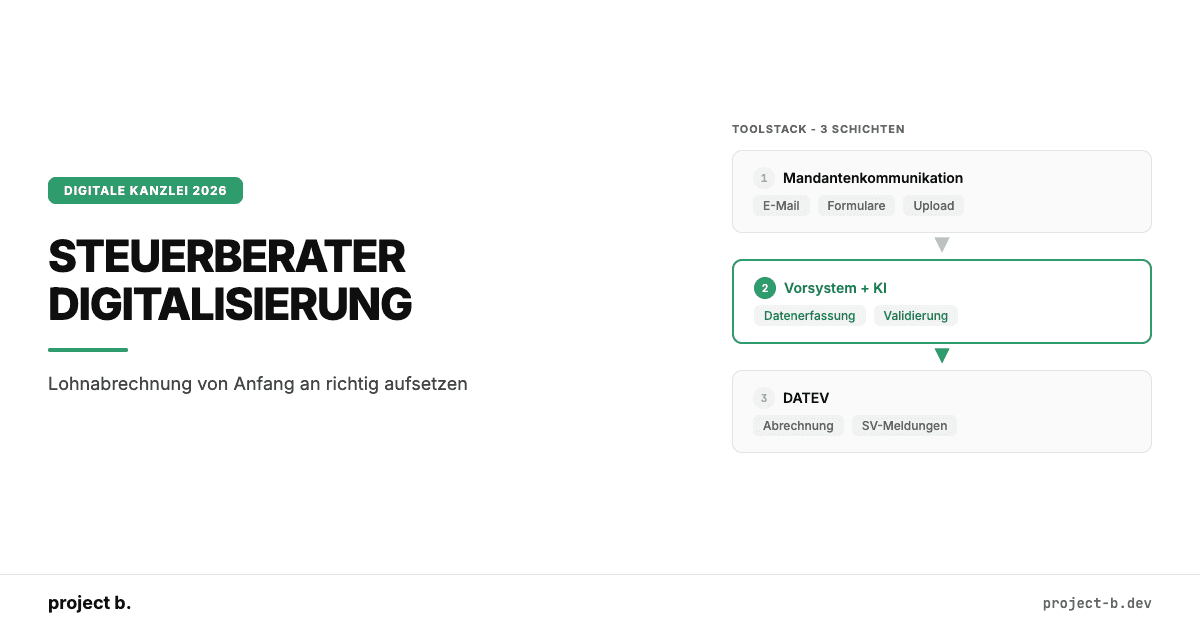
Steuerberater Digitalisierung: Wie neue Kanzleien Lohnabrechnung von Anfang an richtig aufsetzen
No need to spend time changing colors and styles manually. Our component & layouts are styled out of the box
Apr 14, 2026
·
AI
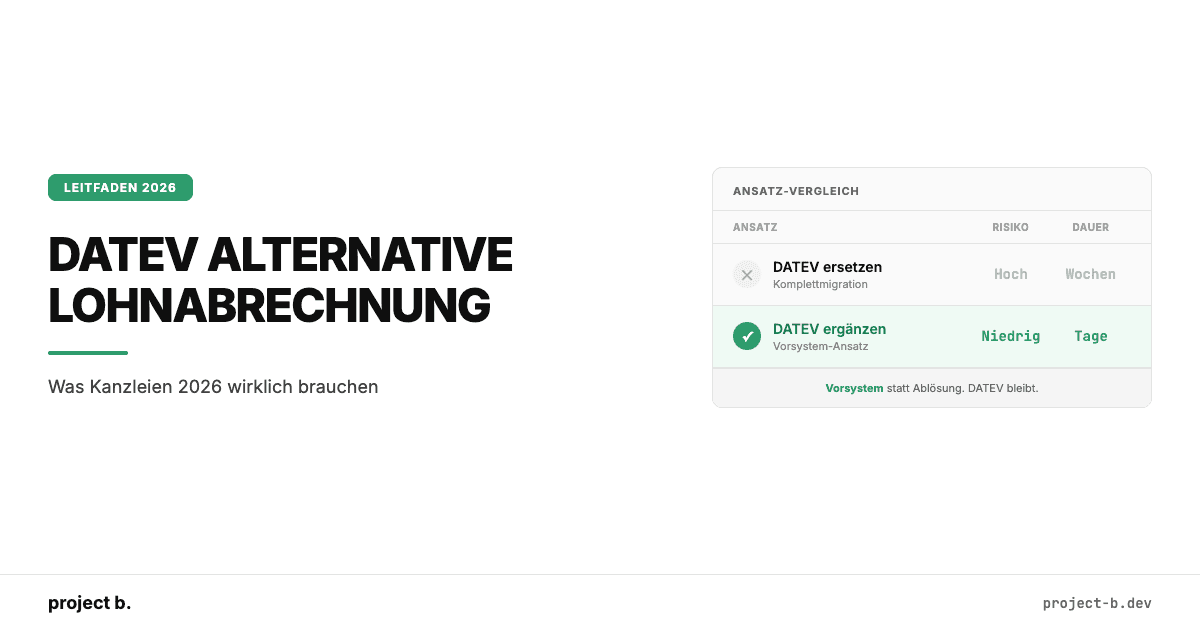
DATEV Alternative Lohnabrechnung: Was Kanzleien 2026 wirklich brauchen
DATEV Alternative für die Lohnabrechnung gesucht? Warum ein Vorsystem sinnvoller ist als ein kompletter Wechsel. Mit Kostenvergleich und Praxisbeispiel.
Apr 9, 2026
·
AI
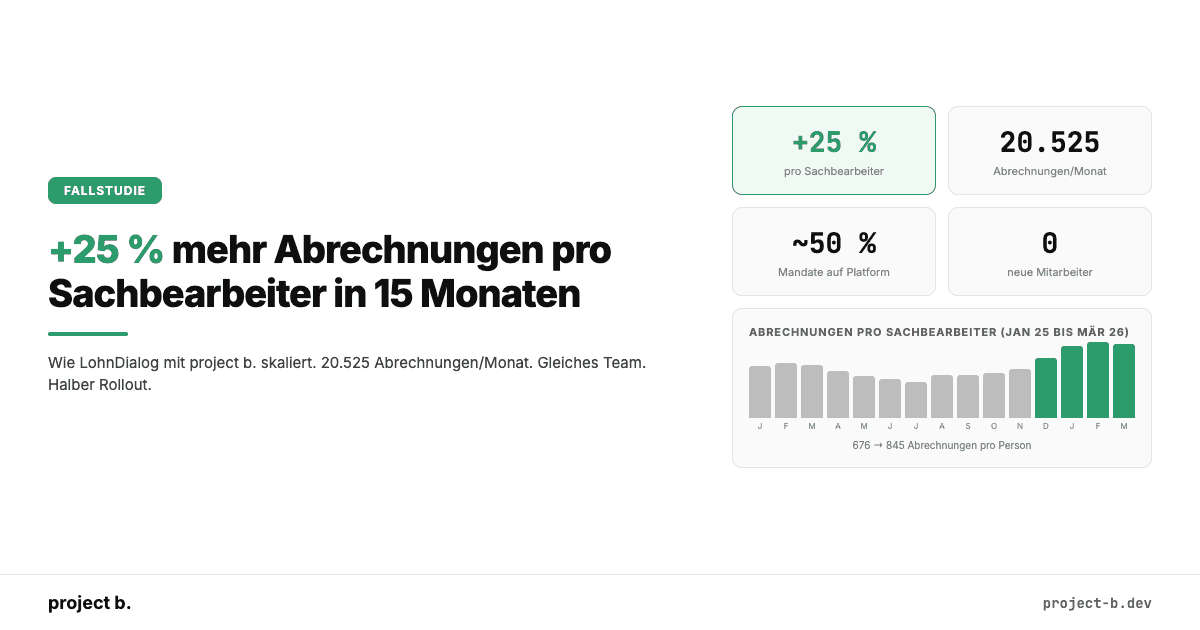
+25 % mehr Abrechnungen pro Sachbearbeiter: Wie LohnDialog mit project b. skaliert
LohnDialog verarbeitet 20.525 Abrechnungen pro Monat mit 24 Sachbearbeitern. Kein neues Personal. +25 % Effizienz nach 15 Monaten. Die Zahlen im Detail.
Apr 7, 2026
·
AI
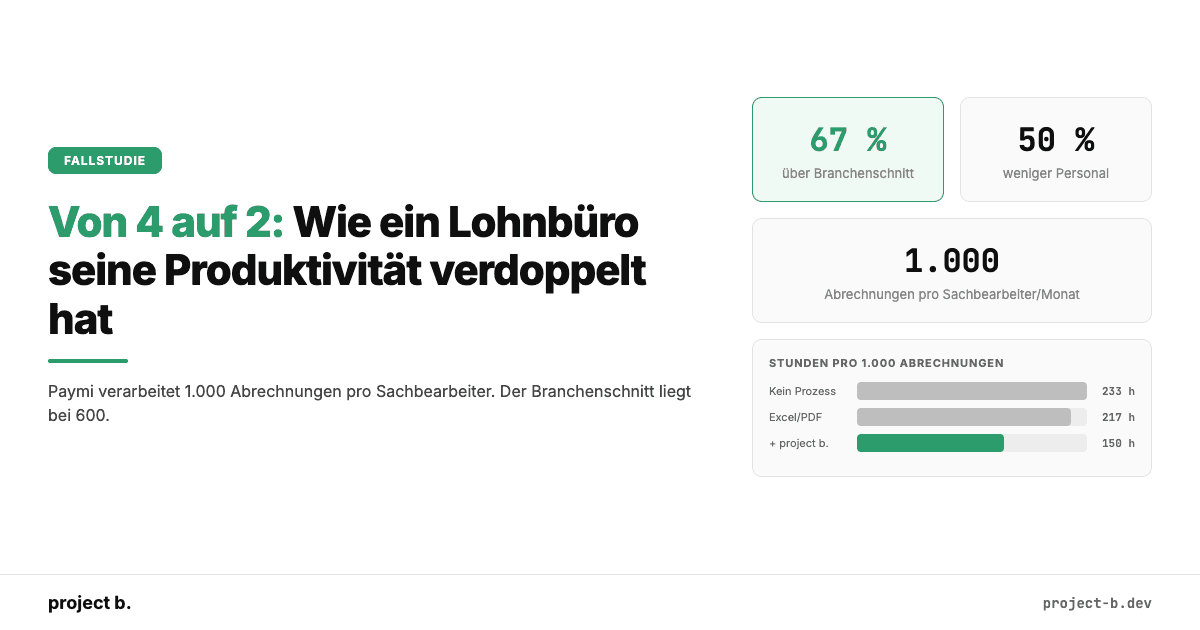
Von 4 auf 2: Wie ein Lohnbüro seine Produktivität verdoppelt hat
Wie der PSP Paymi mit project b. von 4 auf 2 FTEs reduzierte und 1.000 Abrechnungen pro Person verarbeitet. 67 % über Branchenschnitt. Mit Zahlen.
Apr 1, 2026
·
Payment
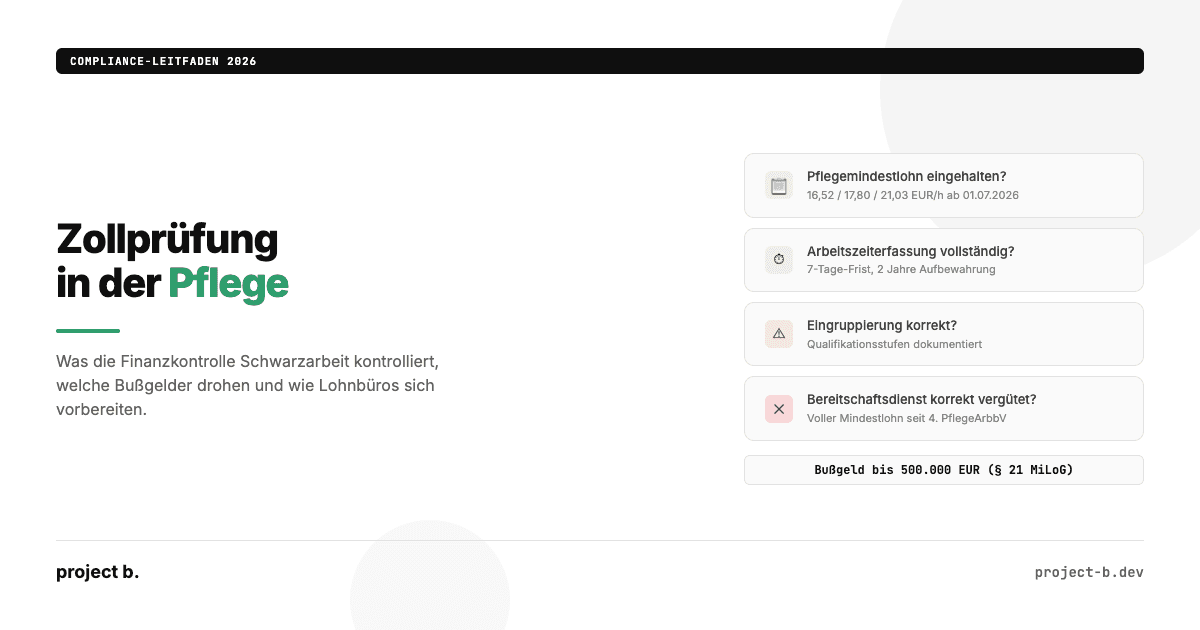
Zollprüfung Pflege 2026: Was die FKS kontrolliert und wie Sie sich vorbereiten
Was die Finanzkontrolle Schwarzarbeit in Pflegeeinrichtungen prüft: Mindestlohn, Arbeitszeiterfassung, Dokumentation. Bußgelder bis 500.000 EUR und wie Sie sich schützen.
Mar 30, 2026
·
Payment
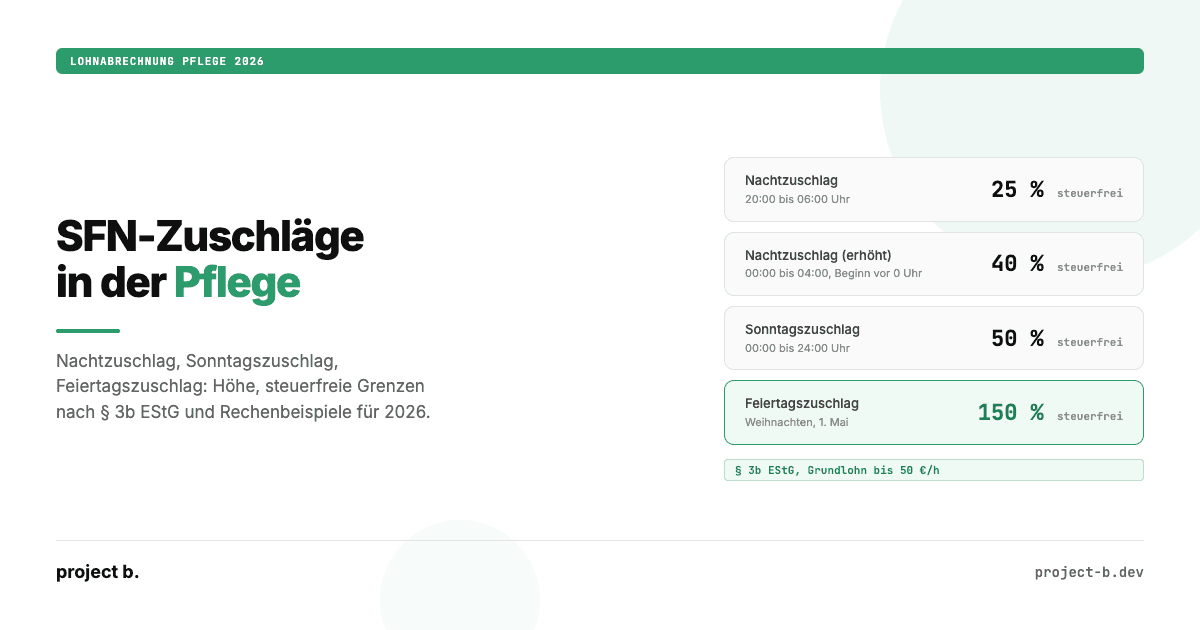
Zuschläge Pflege 2026: Nacht-, Sonntags- und Feiertagszuschläge korrekt abrechnen
Nachtzuschlag, Sonntagszuschlag, Feiertagszuschlag in der Pflege 2026: Höhe, steuerfreie Grenzen nach § 3b EStG, Rechenbeispiele und typische Abrechnungsfehler.
Mar 27, 2026
·
Payment
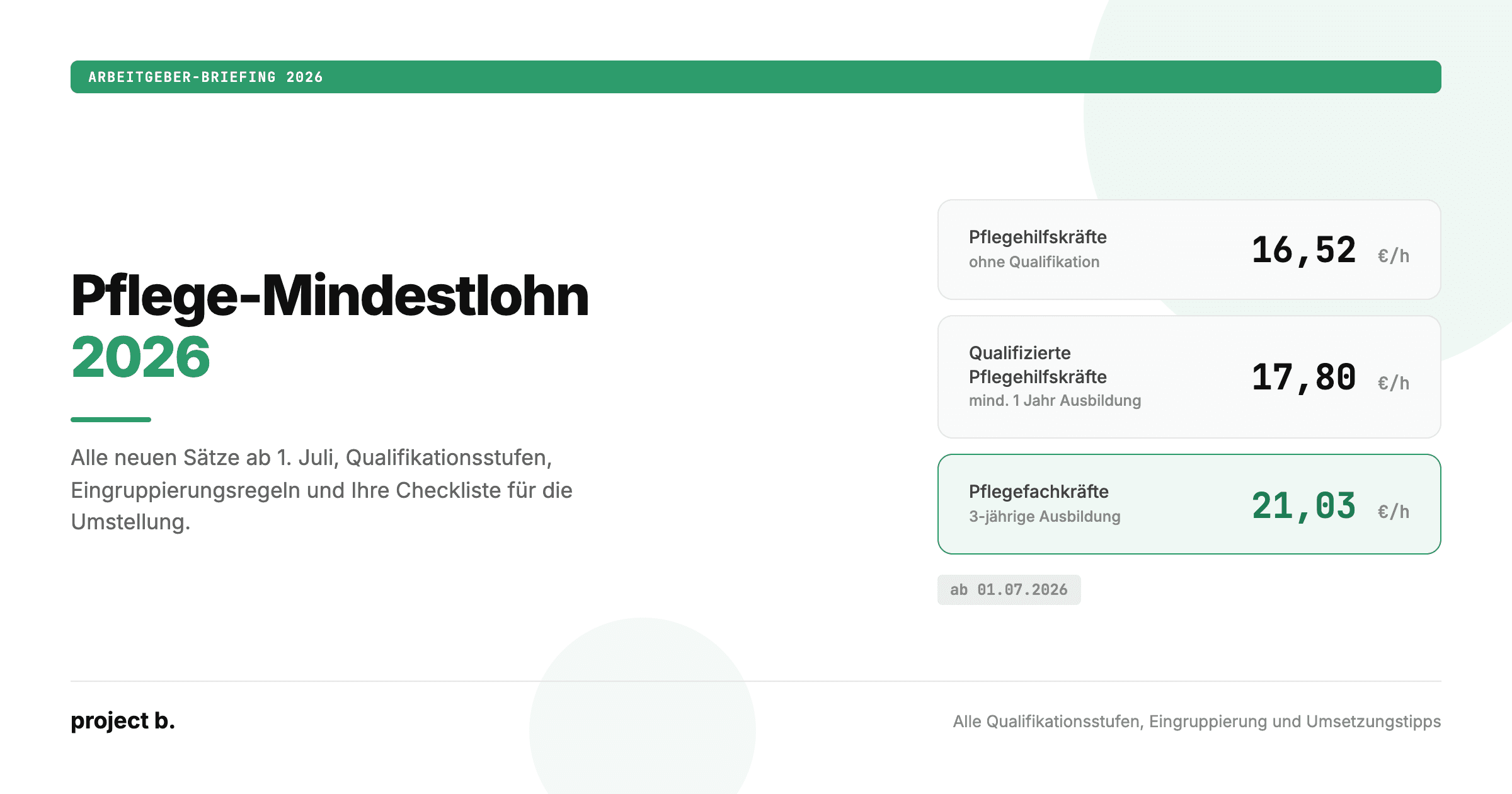
Pflegemindestlohn 2026: Alle neuen Sätze, Tabellen und Eingruppierungsregeln
Pflegemindestlohn 2026 ab 1. Juli: 16,52 bis 21,03 Euro pro Stunde. Alle drei Qualifikationsstufen, Eingruppierungsregeln und was Arbeitgeber jetzt umsetzen müssen.
Mar 20, 2026
·
Outsourcing
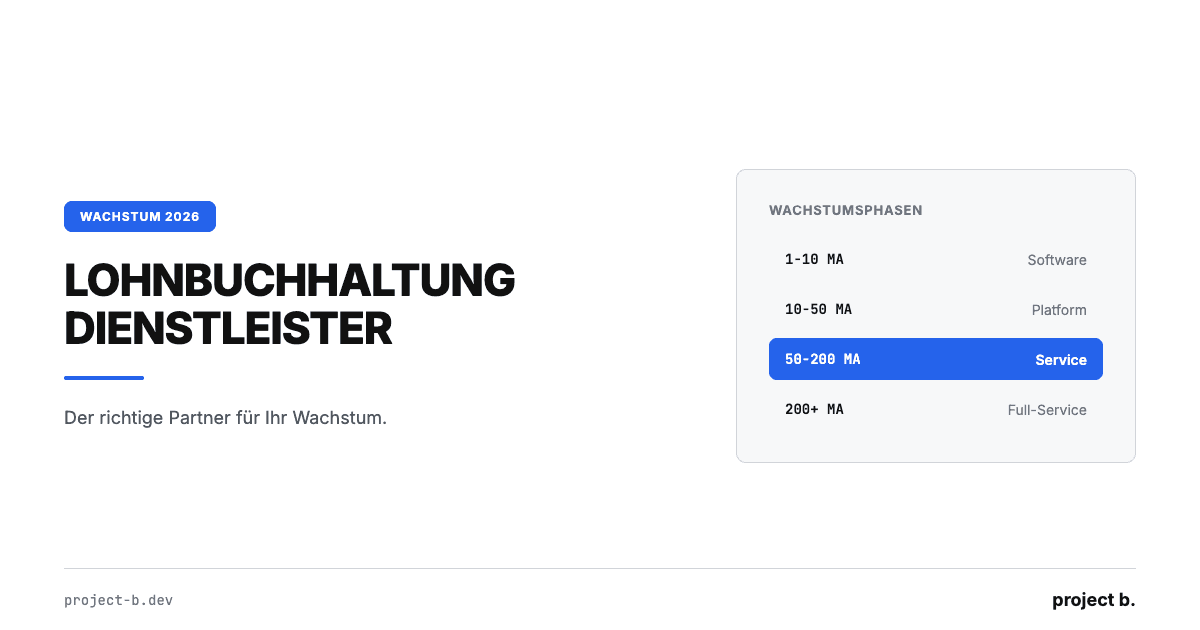
Lohnbuchhaltung Dienstleister: Der richtige Partner für Ihr Wachstum
Lohnbuchhaltung Dienstleister finden, der mit Ihrem Unternehmen wächst. Kosten, Phasenmodell und 5 Kriterien für skalierbare Lohnabrechnung ab 4 €/MA.
Mar 18, 2026
·
Outsourcing
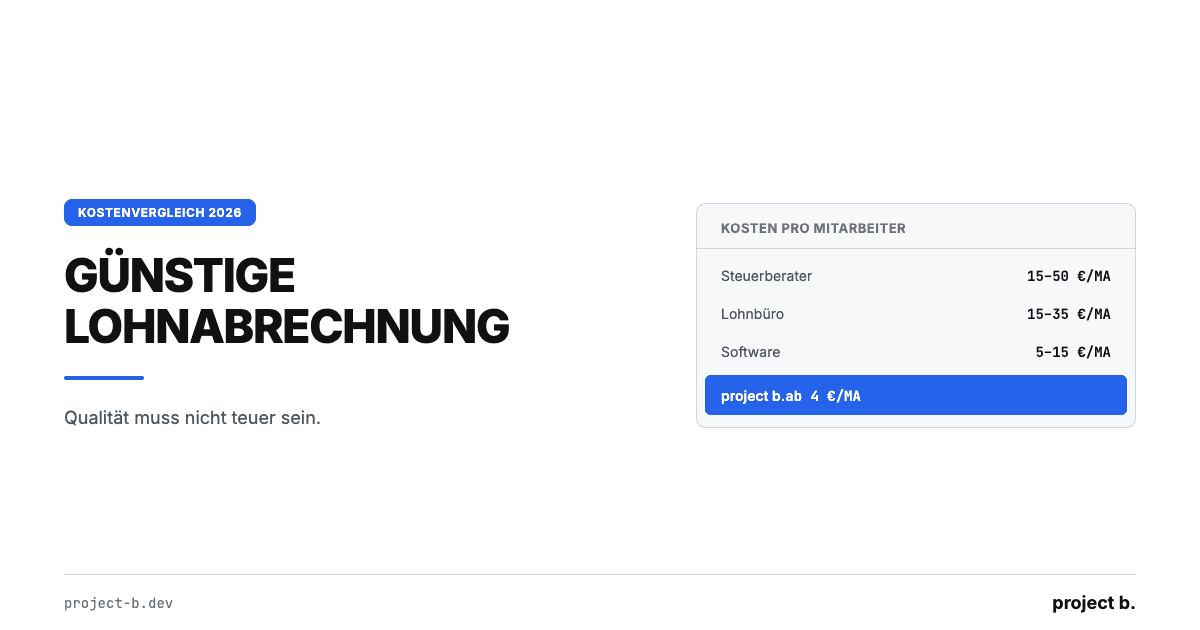
Günstige Lohnabrechnung: Qualität muss nicht teuer sein
Günstige Lohnabrechnung ab 4 €/Mitarbeiter: Kostenvergleich Software, Steuerberater und Outsourcing mit TCO-Rechnung und konkreten Spartipps für KMU.
Mar 16, 2026
·
Outsourcing
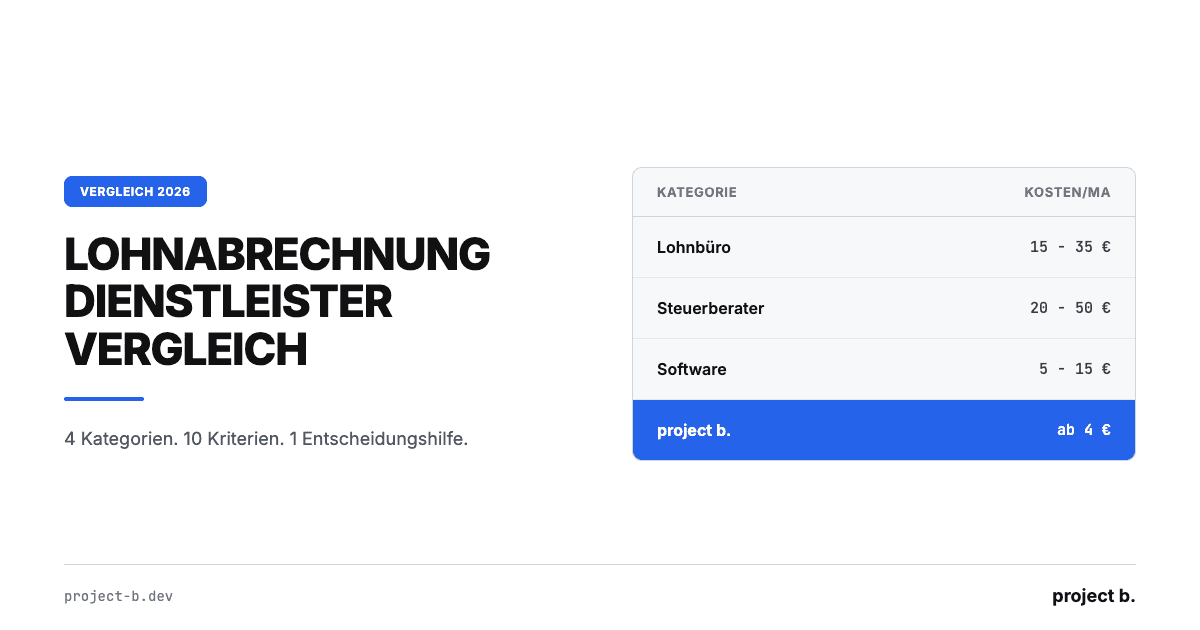
Lohnabrechnung Dienstleister Vergleich: Die Optionen 2026
Lohnabrechnung Dienstleister Vergleich 2026: 4 Kategorien, 10 Kriterien, echte Preise ab 4€/MA. Finden Sie den passenden Payroll-Partner für Ihr Unternehmen.
Mar 13, 2026
·
Outsourcing
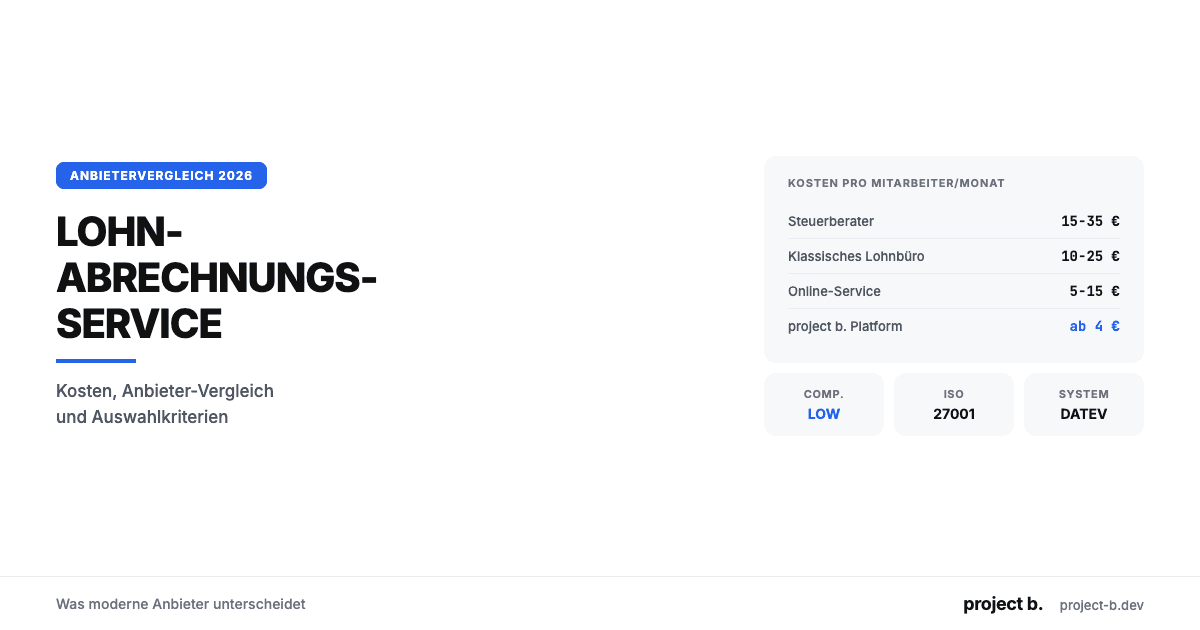
Lohnabrechnungsservice: Was moderne Anbieter unterscheidet
Lohnabrechnungsservice gesucht? Kosten ab 6 €/MA, Anbieter-Vergleich, Online vs. vor Ort und worauf Sie bei der Auswahl achten sollten. Jetzt informieren.
Mar 11, 2026
·
Outsourcing
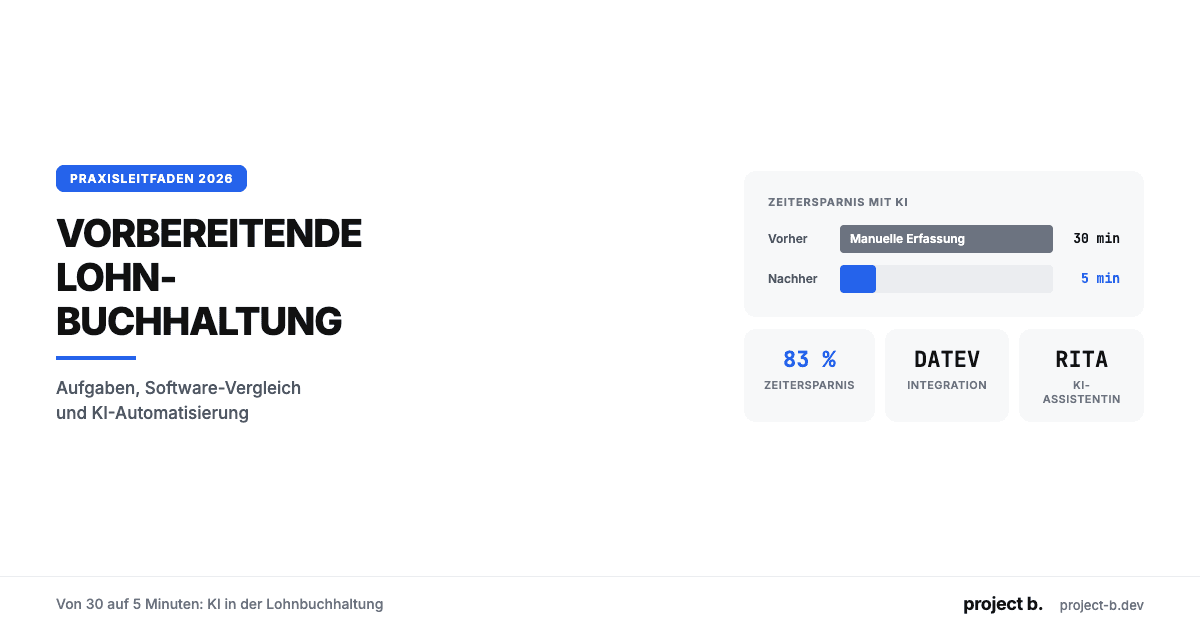
Vorbereitende Lohnbuchhaltung: Von 30 auf 5 Minuten
Was ist vorbereitende Lohnbuchhaltung? Aufgaben-Checkliste, DATEV-Integration, Software-Vergleich und wie KI den Zeitaufwand von 30 auf 5 Minuten senkt.
Mar 9, 2026
·
Outsourcing
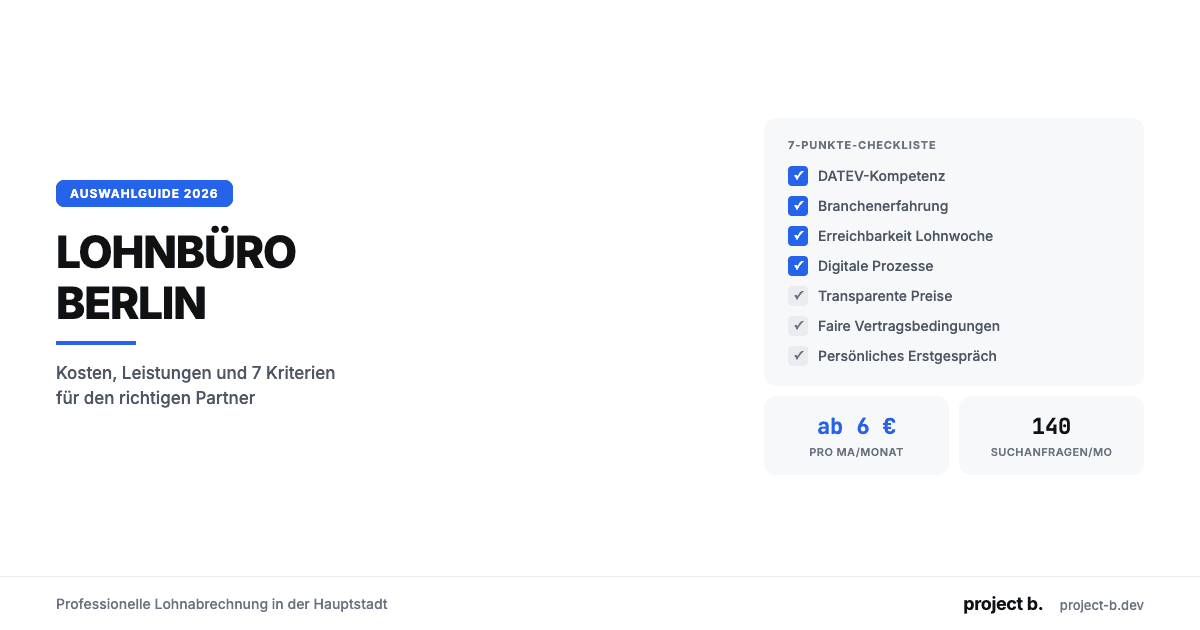
Lohnbüro Berlin: Professionelle Lohnabrechnung in der Hauptstadt
Lohnbüro in Berlin gesucht? Leistungen, Kosten (ab 6 €/MA), 7-Punkte-Checkliste und warum LohnDialog mit project b. Technologie die smarte Wahl ist.
Mar 5, 2026
·
Outsourcing
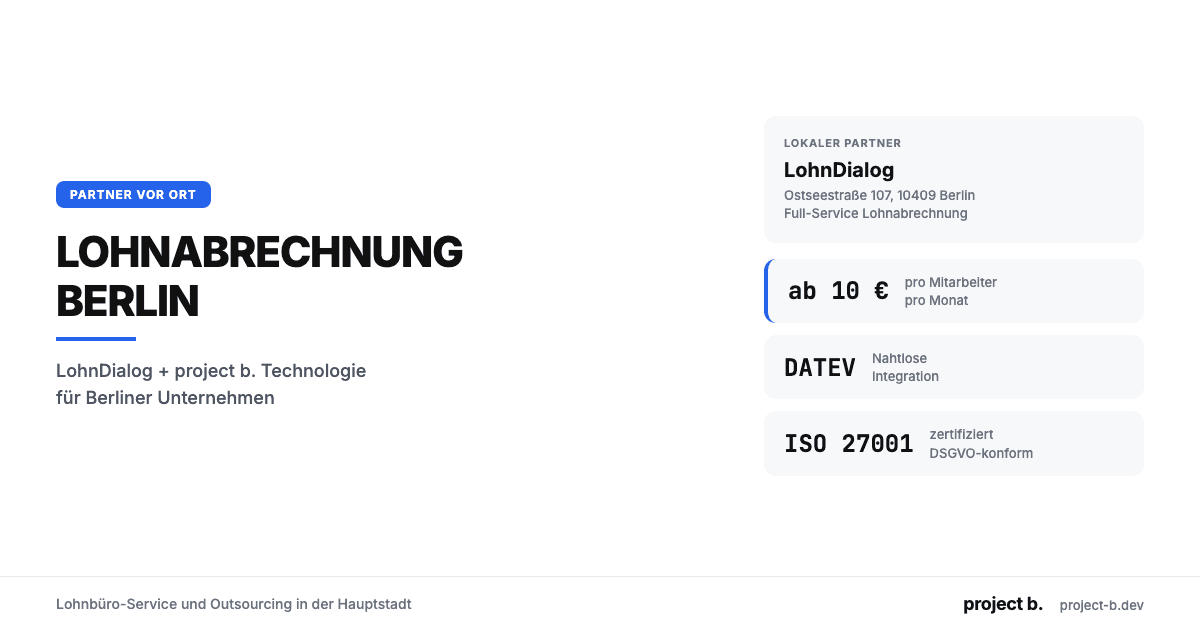
Lohnabrechnung Berlin: Ihr Payroll-Partner in der Hauptstadt
Lohnabrechnung in Berlin mit LohnDialog und project b. Lohnbüro-Service, DATEV-Integration, ab €10/MA. Persönliche Betreuung vor Ort.
Mar 3, 2026
·
Outsourcing
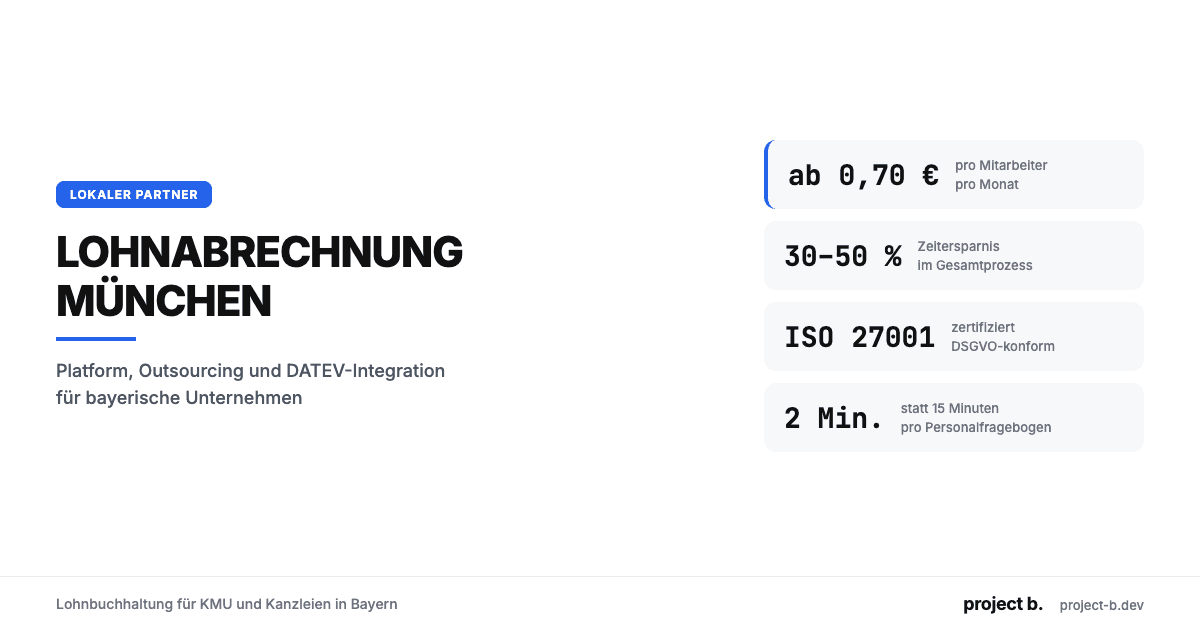
Lohnabrechnung München: Lohnbuchhaltung für KMU & Kanzleien
Lohnabrechnung in München ab €0,70/MA/Monat. Platform oder Outsourcing, DATEV-Integration, ISO 27001. So finden Sie den richtigen Partner.
Feb 27, 2026
·
Outsourcing
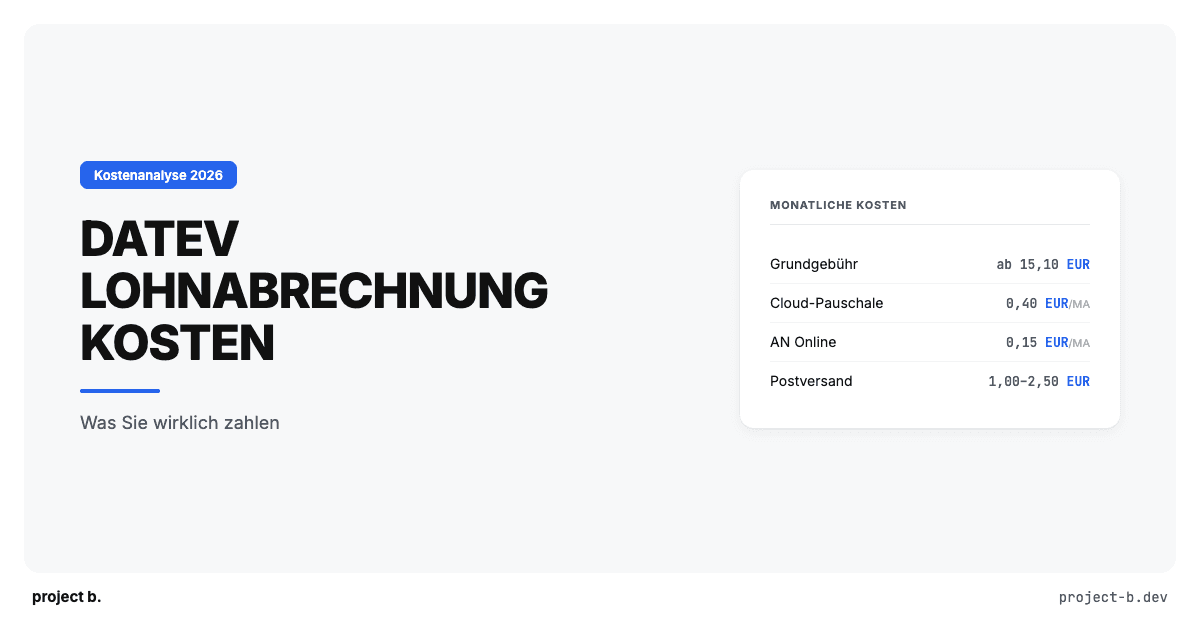
DATEV Lohnabrechnung Kosten: Was Sie wirklich zahlen
Was kostet eine Lohnabrechnung mit DATEV? Preise pro Mitarbeiter, versteckte Zusatzkosten, Vergleich mit Alternativen. Mit konkretem Rechenbeispiel.
Feb 25, 2026
·
Outsourcing
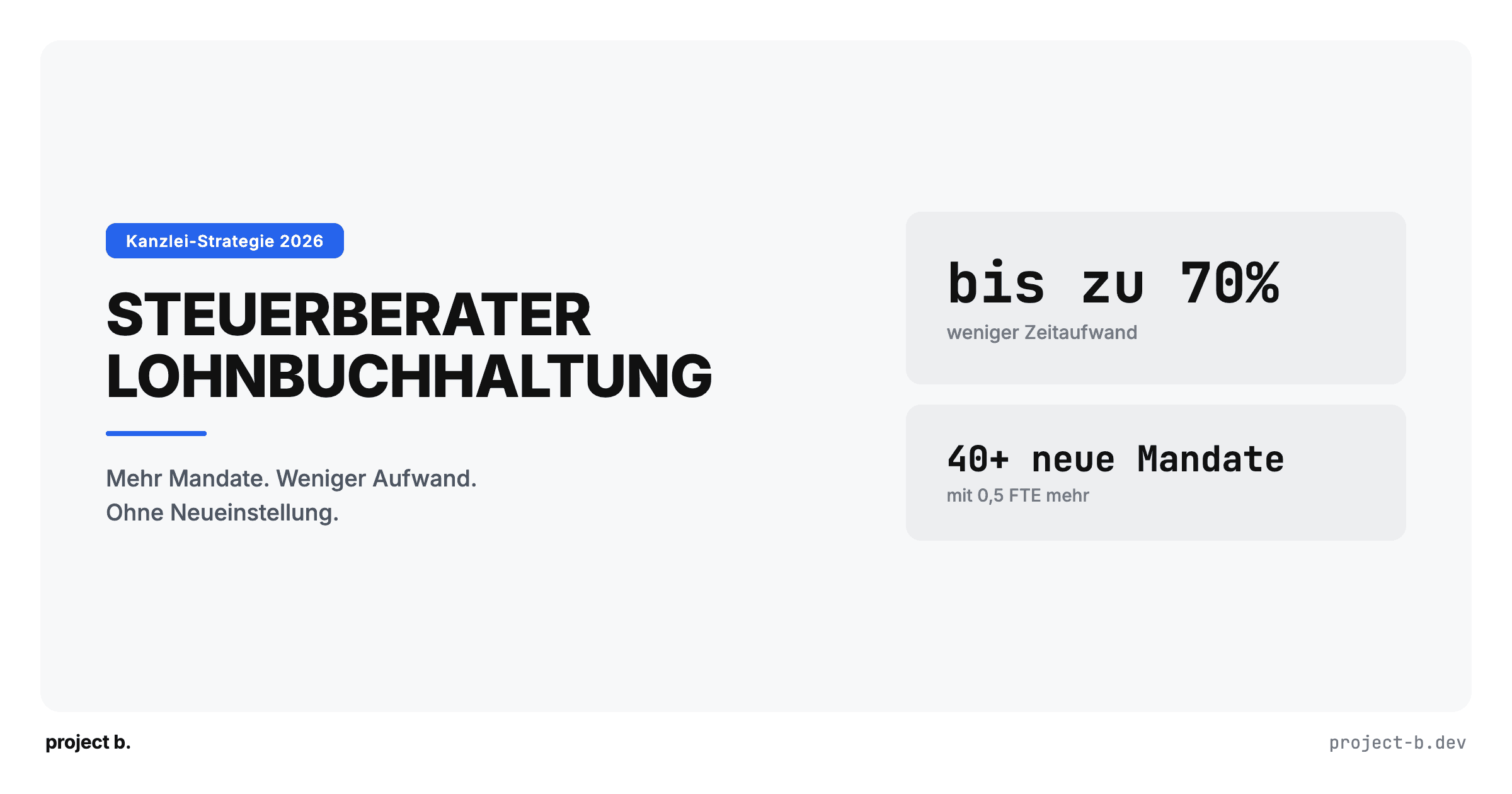
Steuerberater Lohnbuchhaltung: Mehr Mandate ohne mehr Personal
Als Steuerberater mehr Lohnmandate betreuen, ohne proportional Personal aufzubauen? So reduzieren digitale Vorsysteme den Aufwand pro Mandat.
Feb 23, 2026
·
Outsourcing
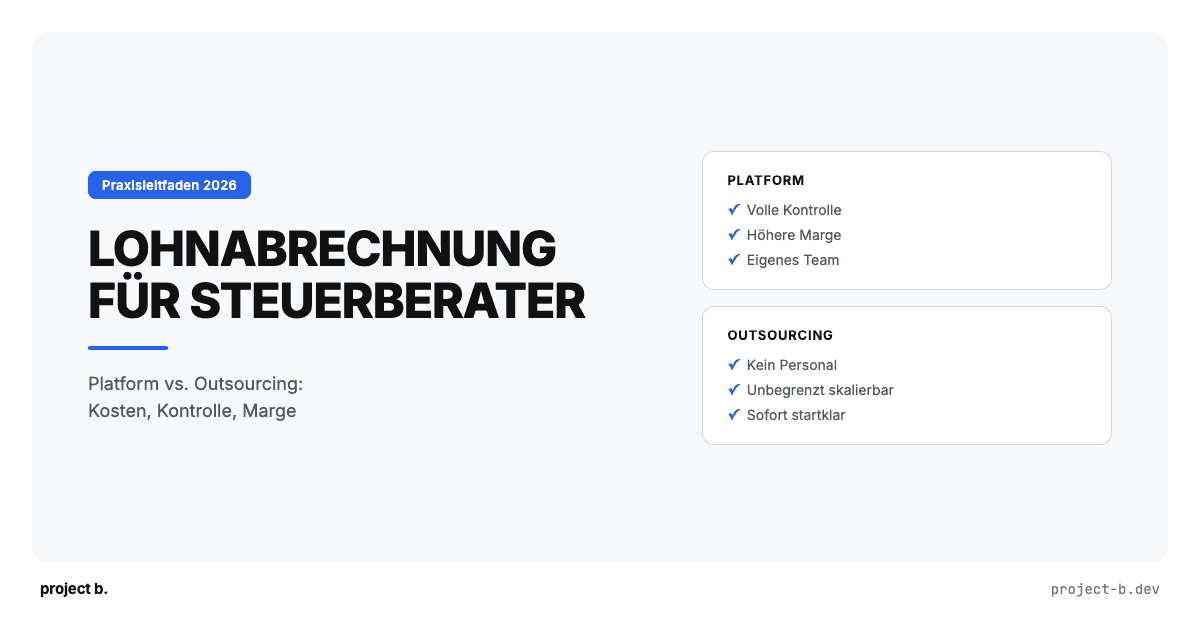
Lohnabrechnung für Steuerberater: Platform vs. Outsourcing
Lohnabrechnung als Steuerberater selbst abrechnen oder auslagern? Vergleich beider Modelle mit Kosten, Aufwand und Praxisbeispiel.
Feb 20, 2026
·
Outsourcing
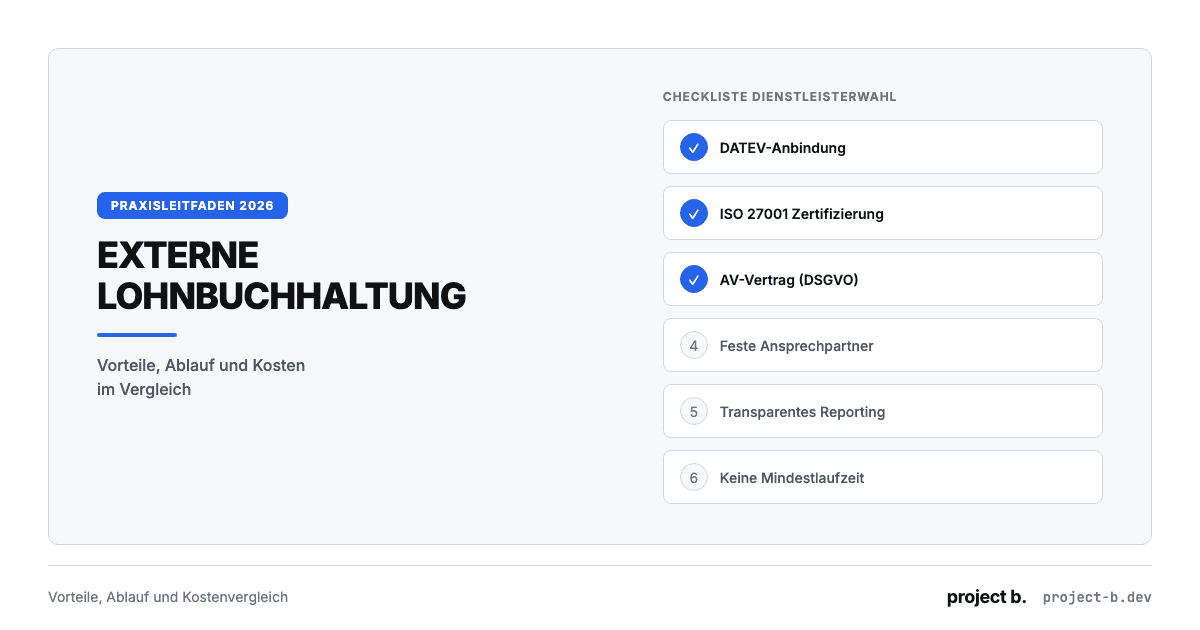
Externe Lohnbuchhaltung: Vorteile, Ablauf und Kosten
Externe Lohnbuchhaltung ab 10 EUR pro Mitarbeiter. Vorteile, typischer Ablauf, Kostenvergleich und worauf Sie bei der Auswahl des Dienstleisters achten sollten.
Feb 18, 2026
·
Outsourcing
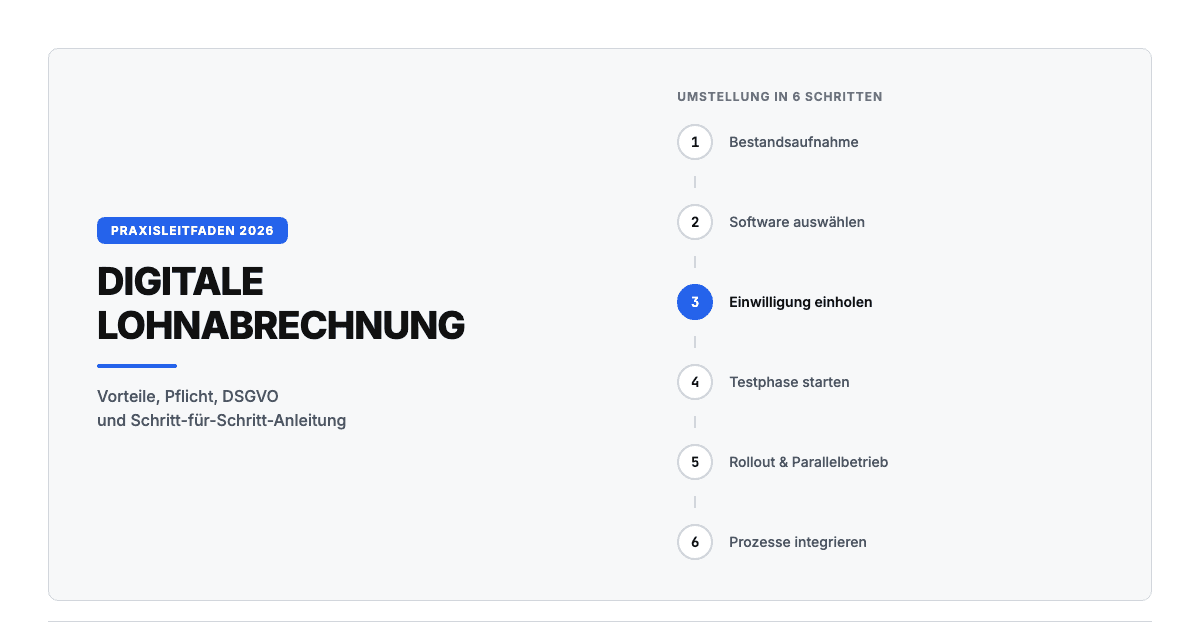
Digitale Lohnabrechnung: So funktioniert sie in der Praxis
Digitale Lohnabrechnung rechtssicher einführen. Vorteile, DSGVO-Anforderungen, Software-Vergleich und Schritt-für-Schritt-Anleitung für die Umstellung 2026.
Feb 16, 2026
·
Outsourcing
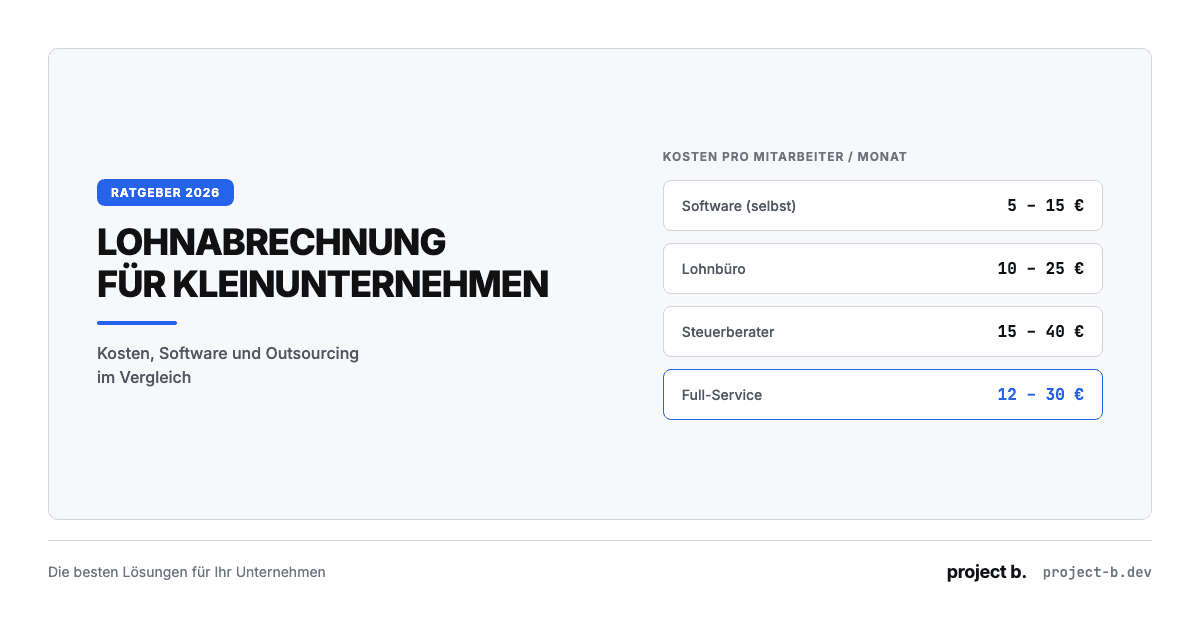
Lohnabrechnung für Kleinunternehmen: Die besten Lösungen 2026
Lohnabrechnung für Kleinunternehmen ab 5 EUR pro Mitarbeiter. Vergleich: selber machen, Software oder outsourcen. Mit Kostenrechnung und Entscheidungshilfe.
Feb 11, 2026
·
Outsourcing
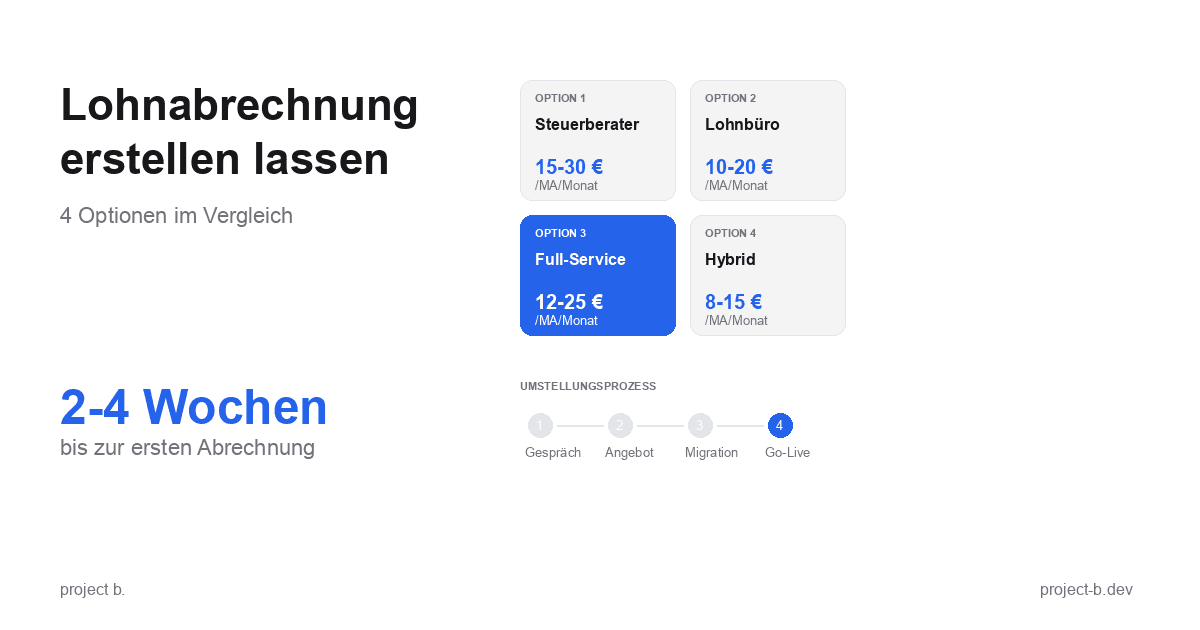
Lohnabrechnung erstellen lassen: Ihre Optionen im Vergleich
Lohnabrechnung erstellen lassen statt selbst kämpfen? Erfahren Sie, welche Optionen Sie haben, was es kostet und wie schnell Sie starten können.
Feb 9, 2026
·
Payment
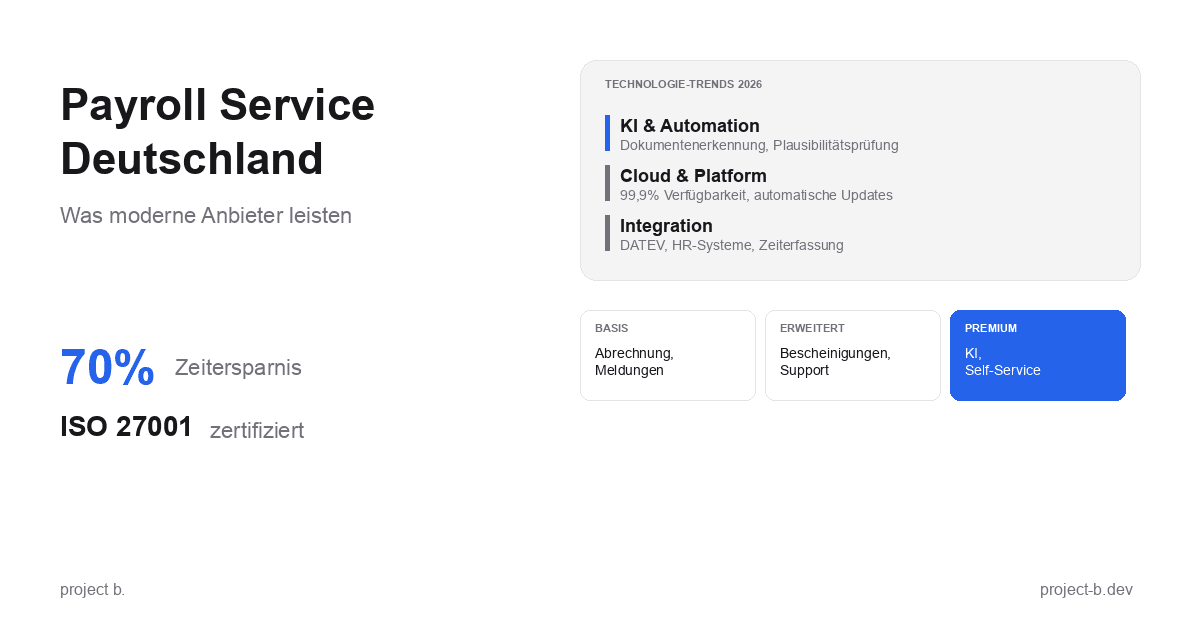
Payroll Service Deutschland: Was moderne Anbieter leisten
Payroll Service in Deutschland gesucht? Erfahren Sie, was moderne Anbieter leisten, welche Technologien sie nutzen und worauf Sie bei der Auswahl achten sollten.
Feb 9, 2026
·
Outsourcing
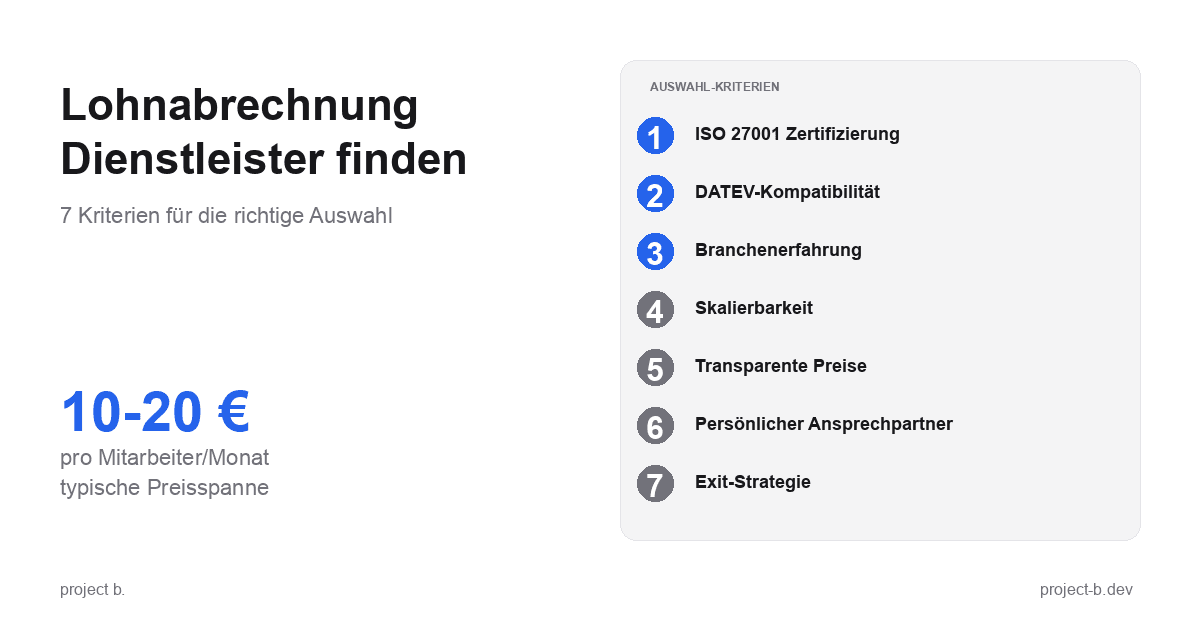
Lohnabrechnung Dienstleister: So finden Sie den richtigen Partner
Lohnabrechnung Dienstleister gesucht? 7 Kriterien für die Auswahl, Preisvergleich und Checkliste fürs Erstgespräch. Finden Sie den Partner, der zu Ihnen passt.
Feb 6, 2026
·
Outsourcing
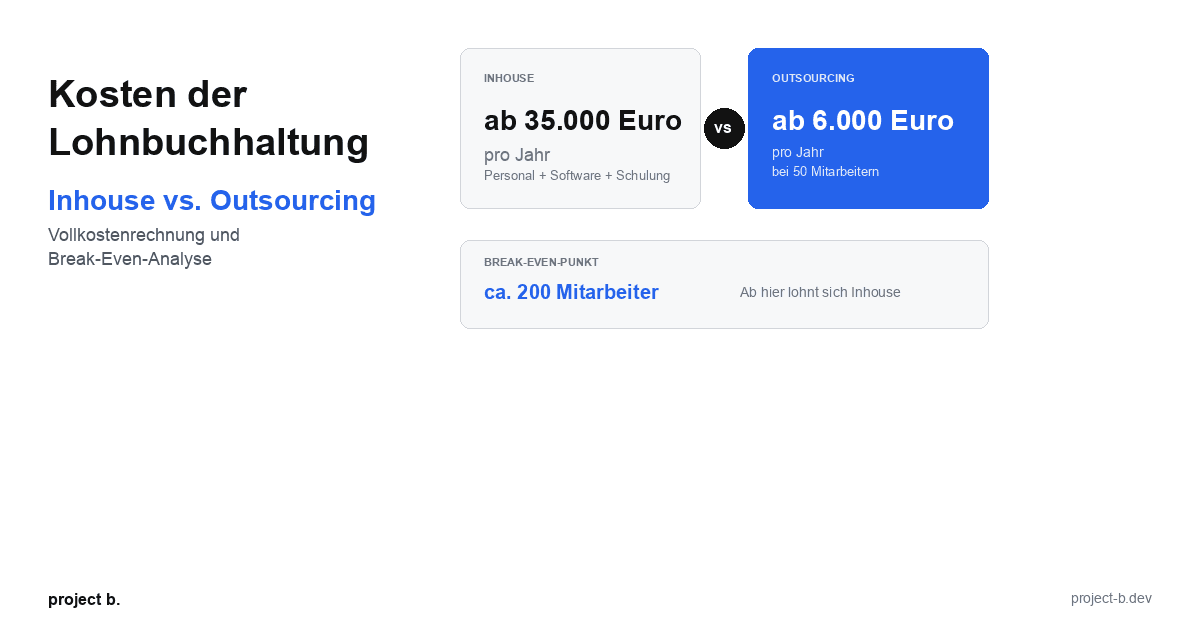
Kosten der Lohnbuchhaltung: Inhouse vs. Outsourcing im Vergleich
Lohnbuchhaltung Kosten: Inhouse ab 35.000 Euro/Jahr vs. Outsourcing ab 6.000 Euro/Jahr. Break-Even-Analyse, ROI-Rechnung und Entscheidungshilfe.
Feb 4, 2026
·
Outsourcing
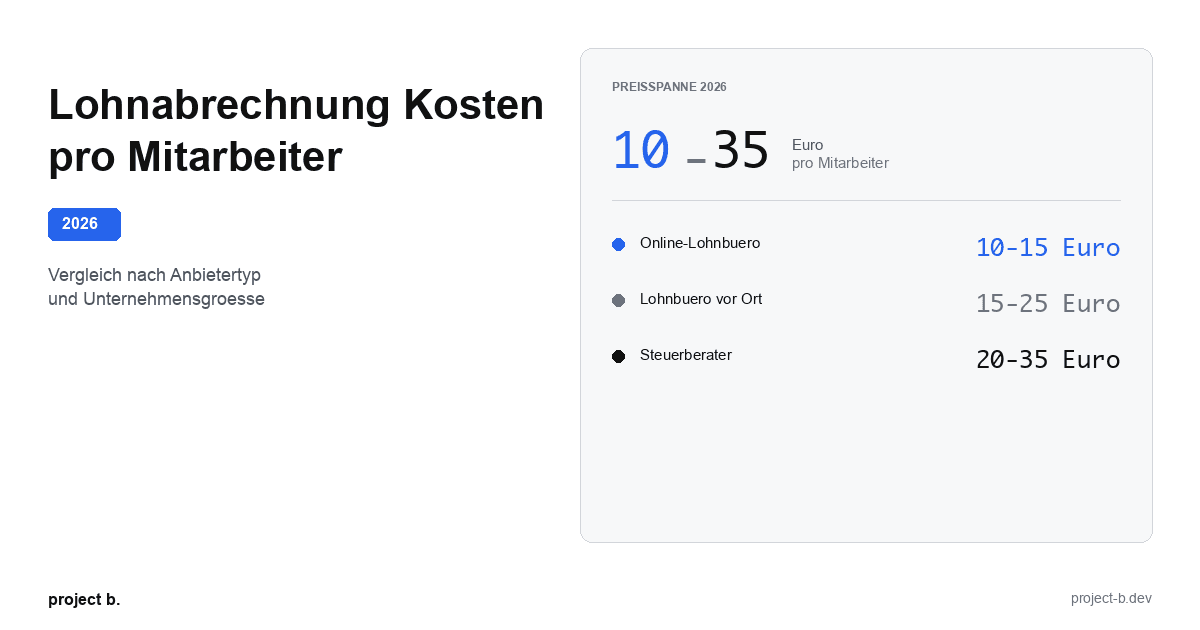
Lohnabrechnung Kosten pro Mitarbeiter: Was Sie 2026 zahlen
Lohnabrechnung Kosten 2026: 10-35 Euro pro Mitarbeiter je nach Anbieter. Vergleich nach Unternehmensgroesse, Branche und versteckte Kosten aufgedeckt.
Feb 2, 2026
·
Outsourcing
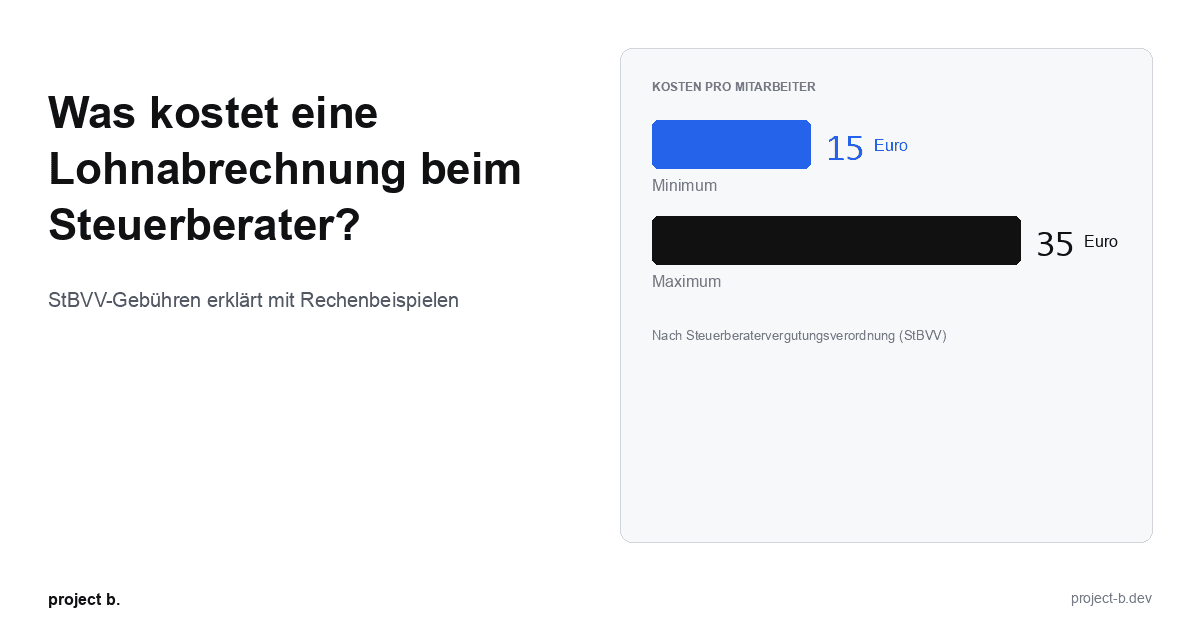
Was kostet eine Lohnabrechnung beim Steuerberater?
Lohnabrechnung beim Steuerberater: Kosten von 15-35 € pro Mitarbeiter. StBVV-Gebühren erklärt, Preisvergleich und Rechenbeispiele für 10, 50, 100 Mitarbeiter.
Jan 30, 2026
·
Outsourcing
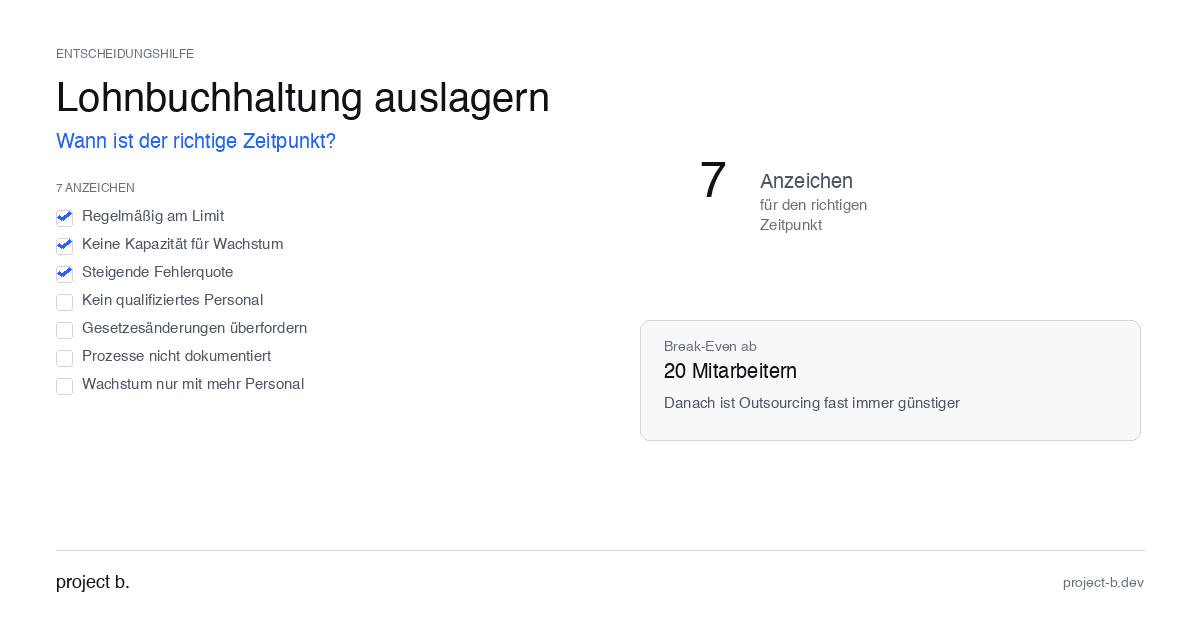
Outsource payroll accounting: When is the right time?
Outsourcing payroll: 7 clear signs that now is the right time. Including break-even analysis and DATEV integration check.
Jan 28, 2026
·
Outsourcing
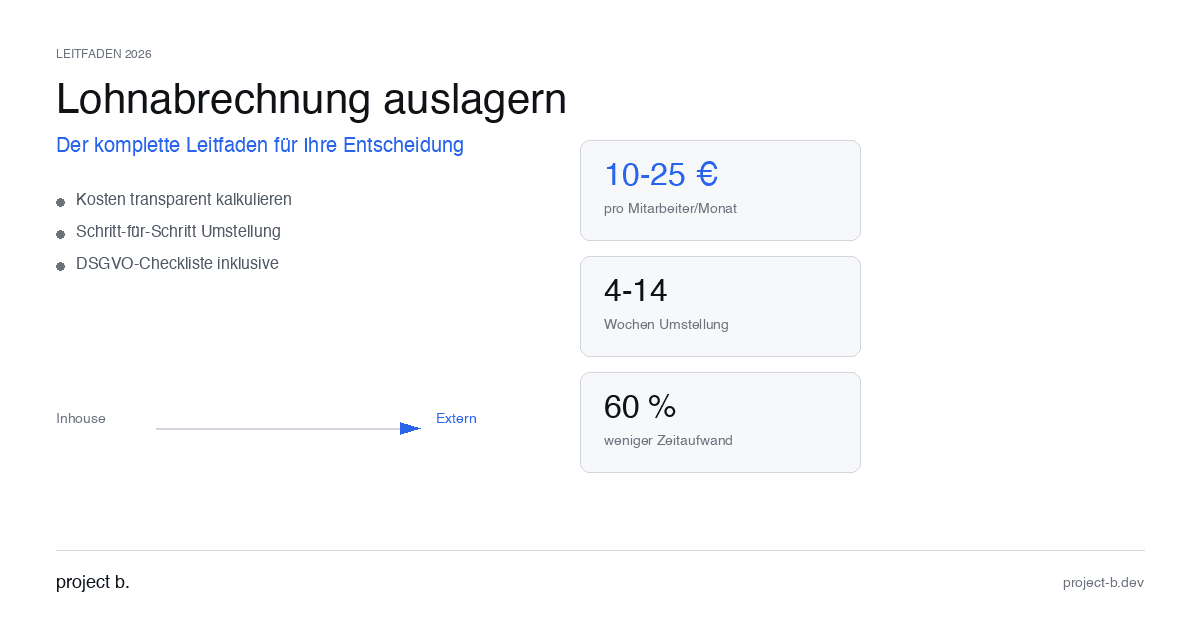
Outsourcing payroll accounting: The complete guide for 2026
Outsource payroll processing 2026: Costs from €10 per employee, step-by-step guide and GDPR checklist. This is how to make the transition without risk.
Jan 26, 2026
·
Outsourcing
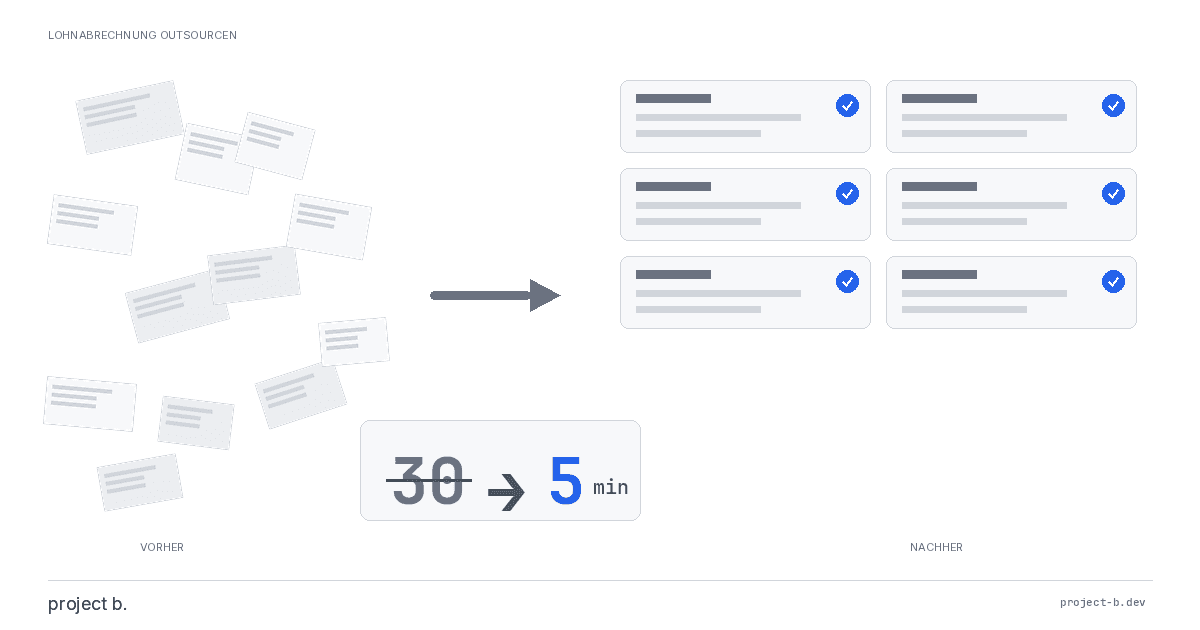
Outsourcing payroll: Costs, benefits, and providers at a glance
Outsource payroll accounting from €10 per employee. Learn about the benefits of outsourcing, its costs, and how to find the right provider.
Jan 22, 2026
·
AI
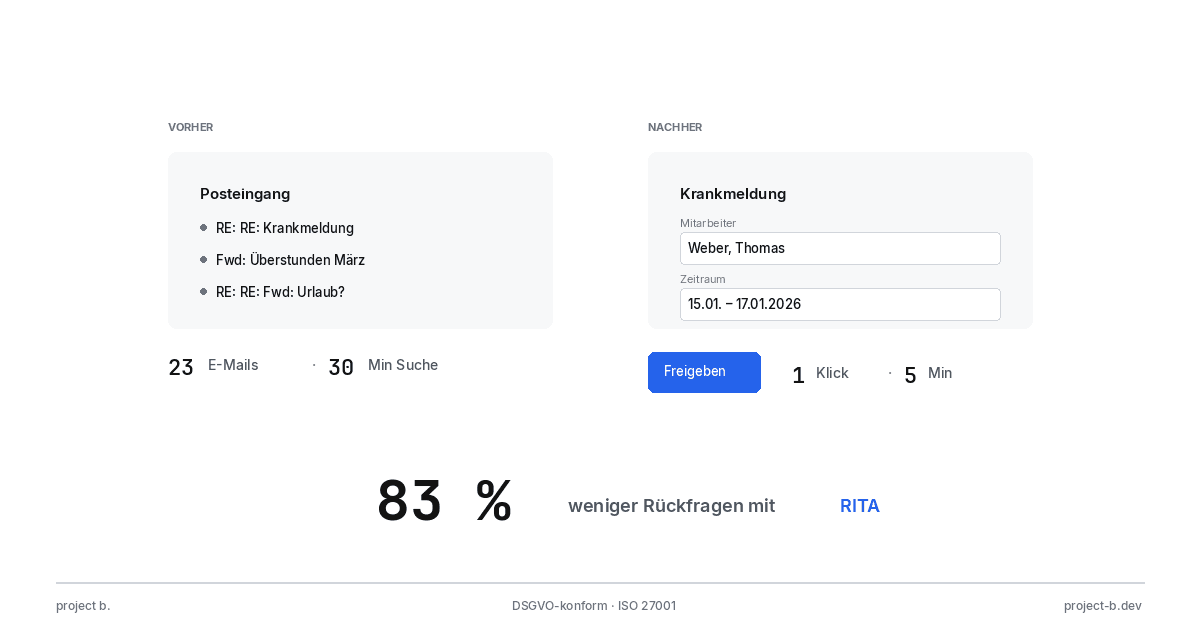
Client portal vs. Email chaos: What modern payroll processing is all about
Payroll statements by email pose a GDPR risk. With the project b. Portal and RITA, you save 1,400 hours/year. This is how secure data exchange works.
Jan 20, 2026
·
AI
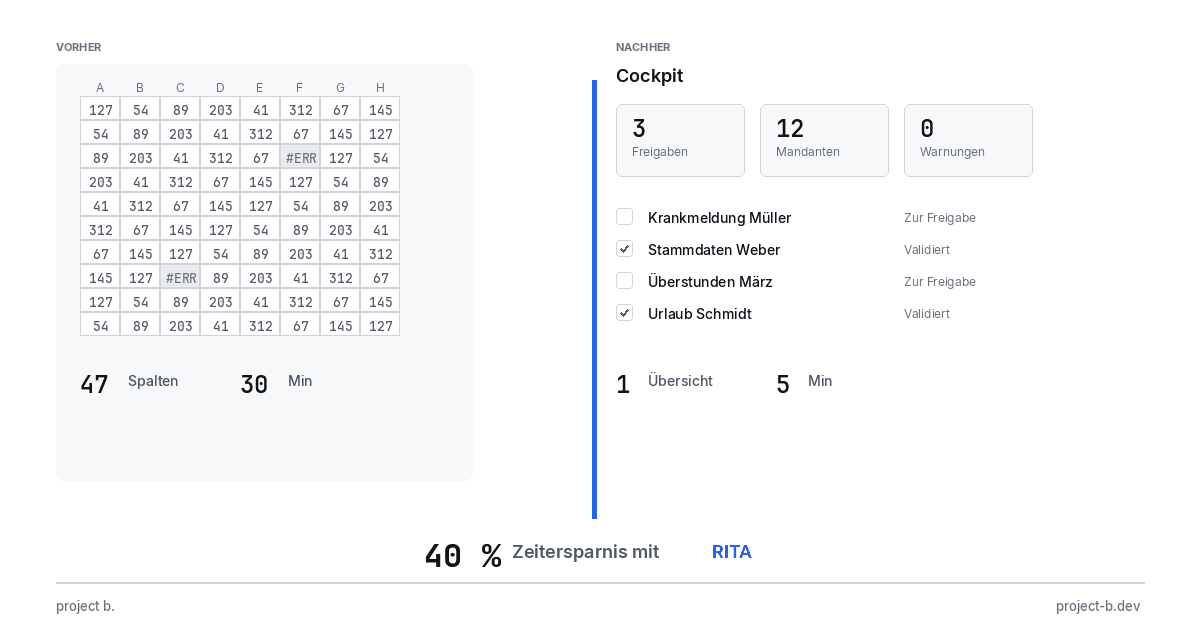
From Excel to the Cockpit: How Payroll Offices Will Make the Leap into Digitalization in 2026
Digital payroll instead of Excel: With RITA and the project b. cockpit, payroll offices save 40% time without switching to DATEV. Practical guide with checklist.
Jan 15, 2026
·
Personal
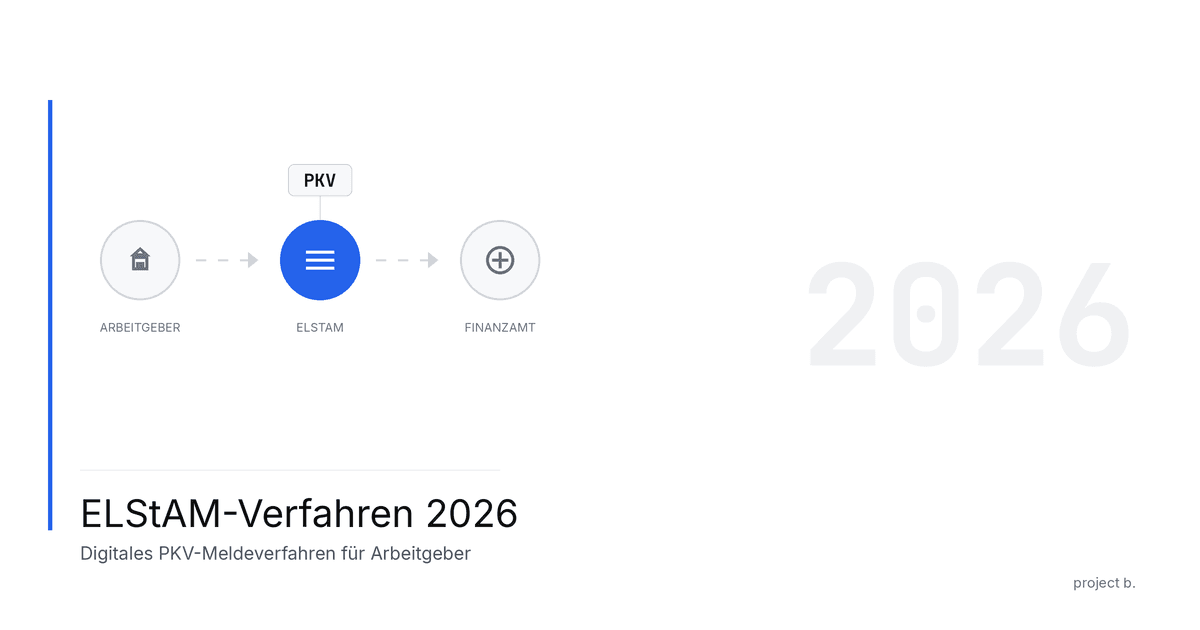
ELStAM Procedure 2026: This is how the new private health insurance notification for employers works
From 2026, employers will report private health insurance contributions digitally via the ELStAM procedure. Find out which systems are affected and how you can prepare now.
Jan 14, 2026
·
AI
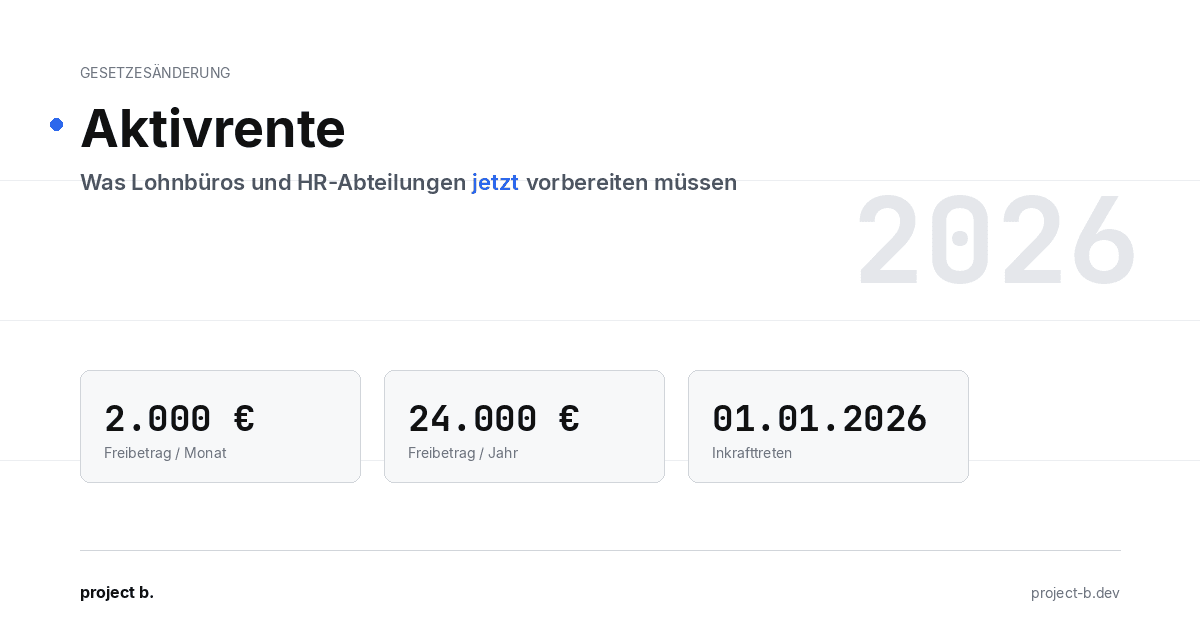
Active pension 2026: What payroll offices and HR departments need to prepare now
Pension from January 2026: Up to €2,000 tax allowance for retirees. Learn about the changes in payroll processes and how AI facilitates implementation.
Jan 8, 2026
·
Payment
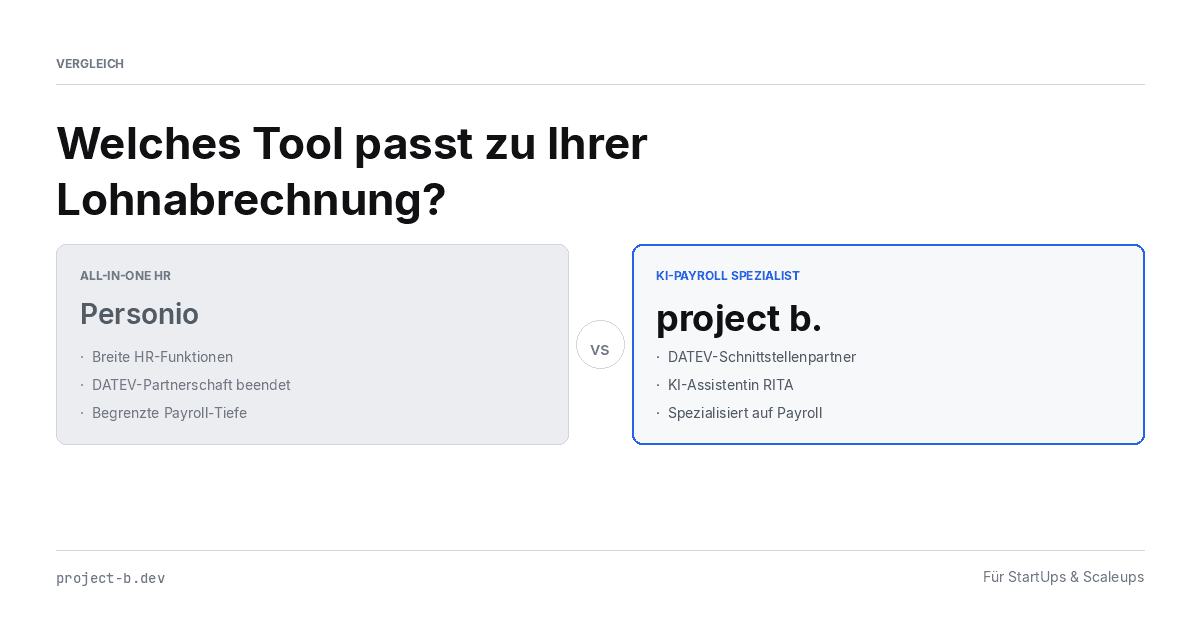
Personio vs. project b.: Which tool really fits your payroll?
Personio or project b.? Comparison for StartUps & Scaleups: DATEV integration, AI automation, costs. Why specialized payroll tools are gaining traction.
Jan 5, 2026
·
AI
Payroll 2026: All Changes at a Glance (with AI Automation)
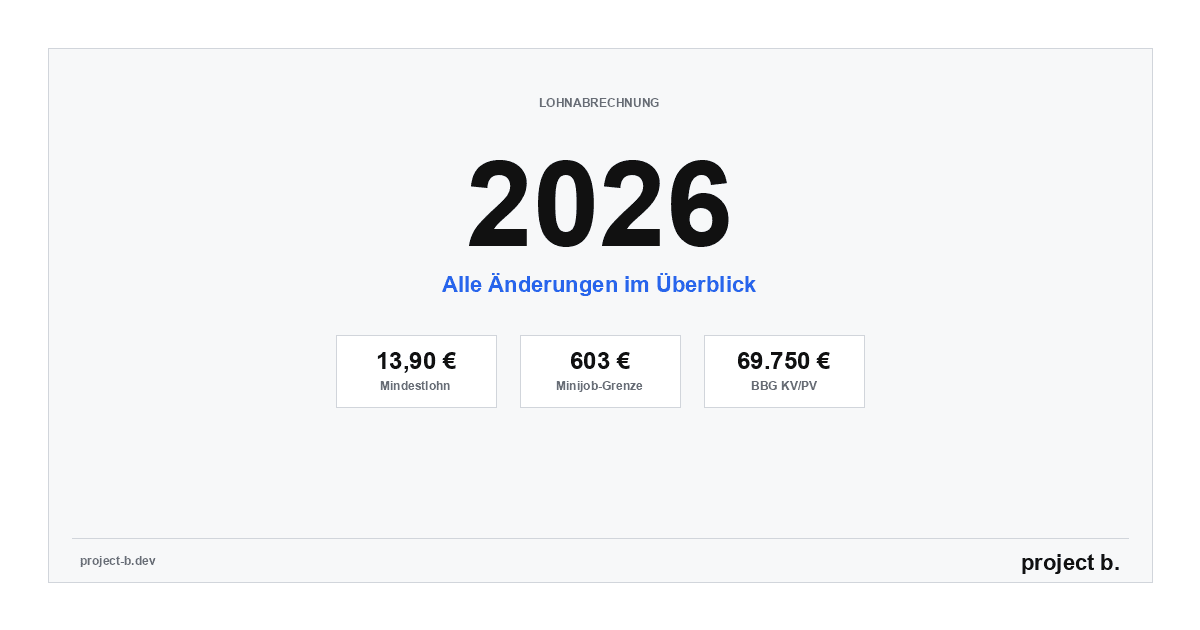
Minimum wage €13.90, mini-job limit €603, new contribution assessment ceilings: An overview of all changes for payroll in 2026. Learn how AI automatically implements these updates.
Jan 4, 2026
·
Payment
Power outage in Berlin: Why employers still have to pay wages
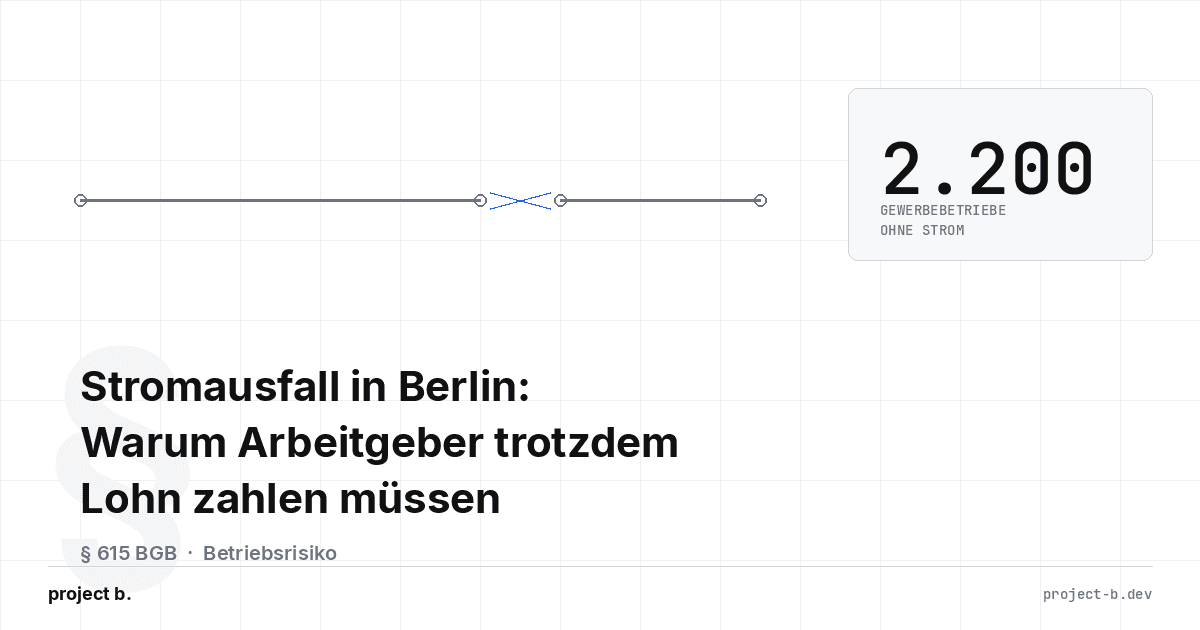
Power outage Berlin 2026: 2,200 businesses affected. Find out why employers must still pay wages according to § 615 BGB - and what applies to payroll.

Dec 31, 2025
·
AI
AI in Payroll: Hype or Help?
AI in payroll processing: What is behind it? A guide for anyone who wants to understand the topic before making a decision.

Dec 29, 2025
·
AI
Payroll without professionals? This is how AI will help in 2026
AI in payroll: 70% less routine work, 0.1% error rate. This is how companies are solving the skilled labor shortage in payroll accounting in 2026.
Dec 26, 2025
·
AI
This is how you use AI in payroll.
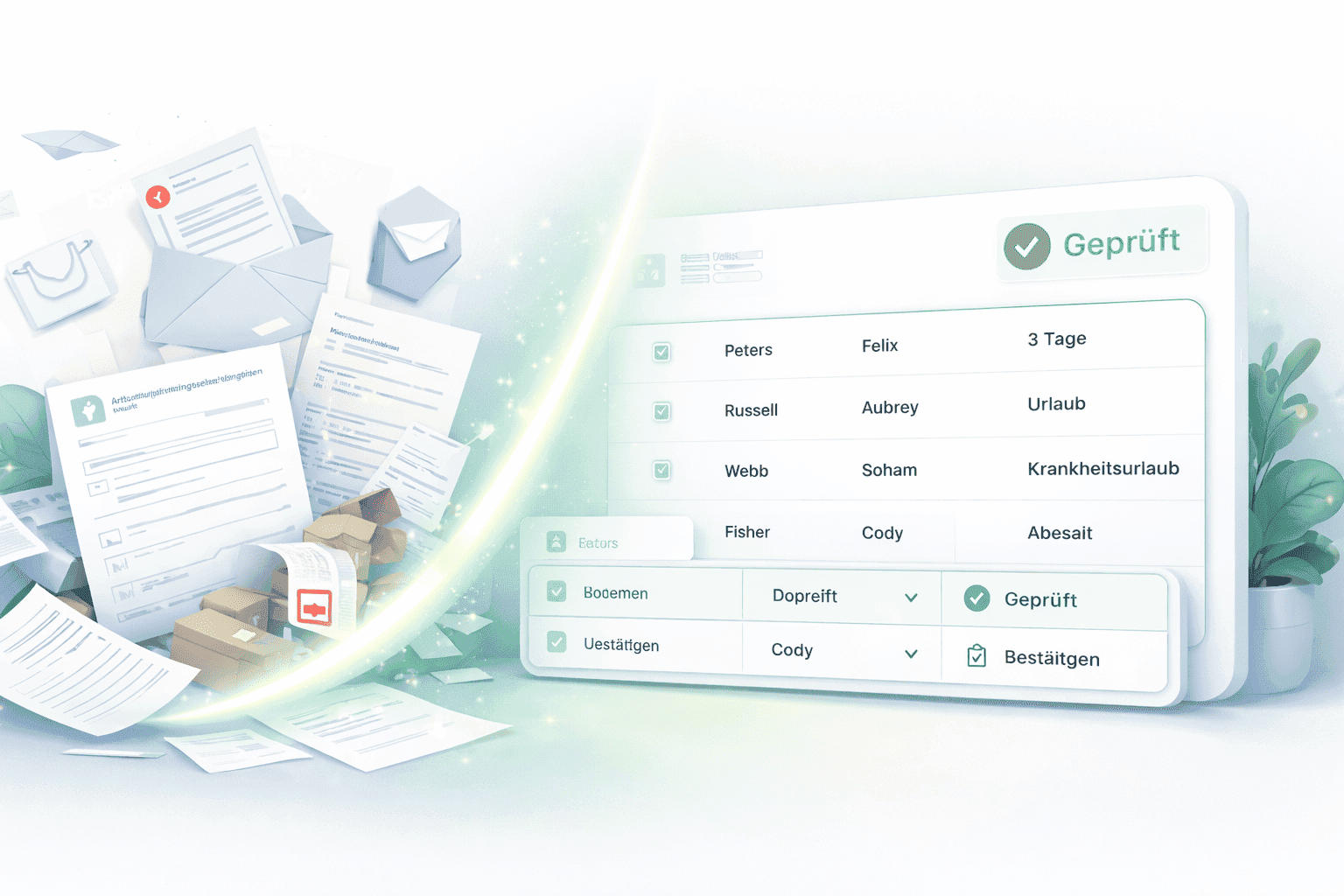
Enough with manual data collection: This is how AI supports payroll accounting in case of sickness notifications, master data, and billing - without loss of control.
Dec 22, 2025
·
AI
How an AI layer works in payroll.
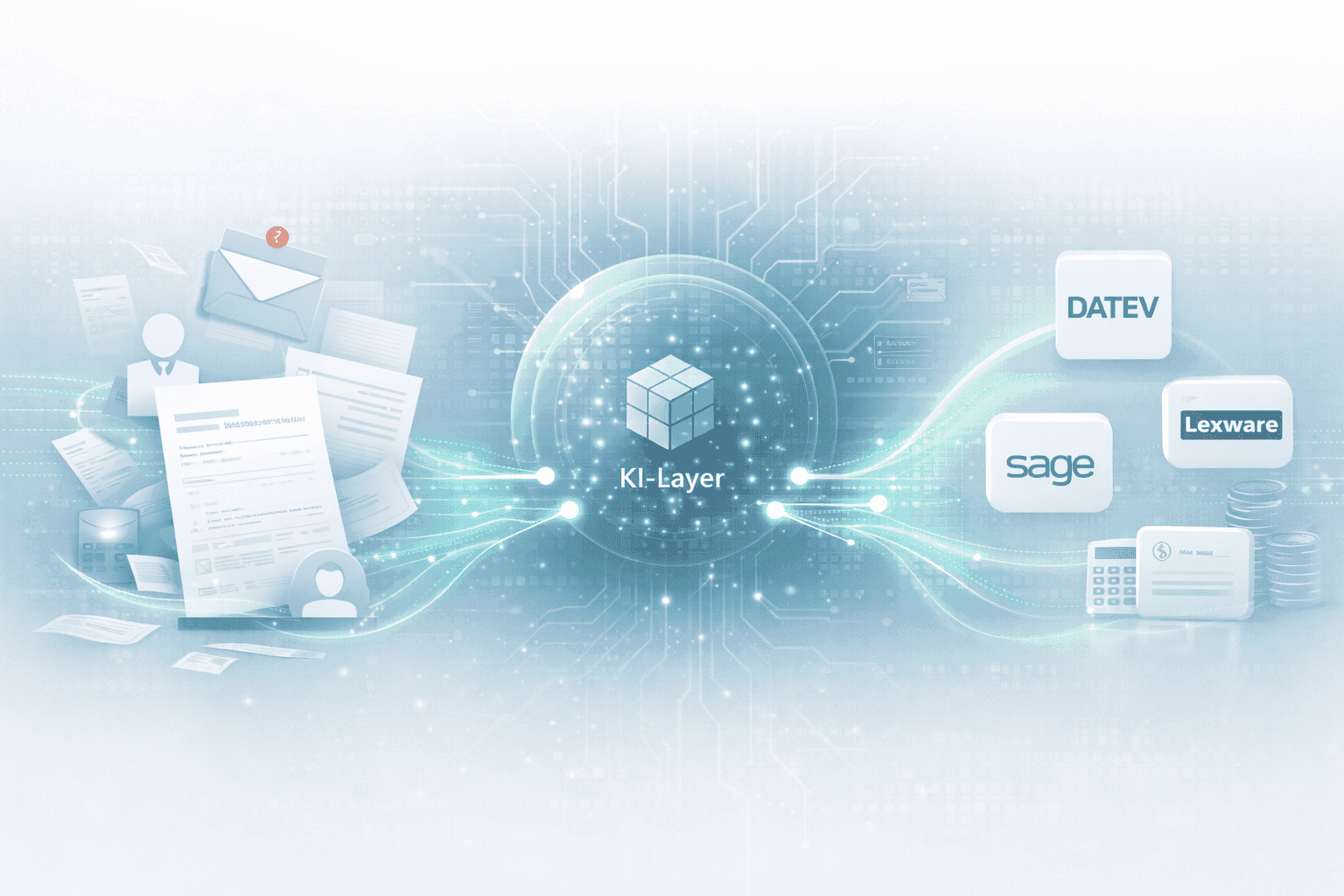
Digital payroll, but manual data entry? An AI layer closes the gap between employees, HR, and DATEV & Co.
Dec 17, 2025
·
AI
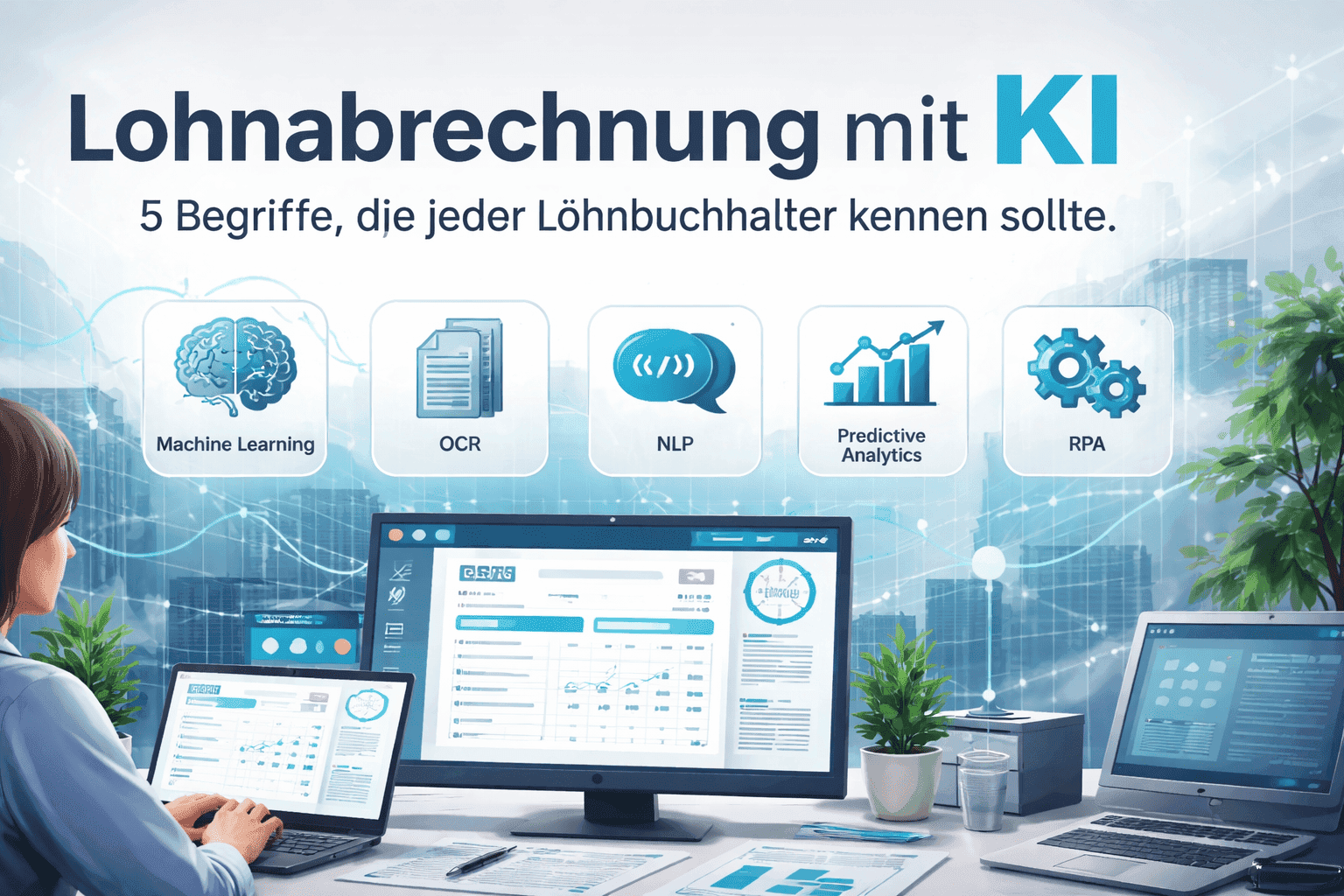
Payroll accounting with AI: 5 terms that every payroll clerk should know
Payroll processing explained clearly with AI: These 5 key AI terms payroll accountants should know to automate processes, reduce errors, and work more efficiently.

Dec 10, 2025
·
AI
How companies automate payroll accounting with Rita
Learn how Rita from project b. has automated the preliminary payroll accounting. From data collection to DATEV integration: This is how payroll agencies and tax consultants save up to 70% time.

Dec 8, 2025
·
AI
AI Software for Payroll Accounting: The Ultimate Selection Guide
Discover the ultimate selection guide for AI software in payroll. Compare AI tools and find the best payroll software for your business.
Dec 5, 2025
·
AI
10 processes in payroll that AI is already handling today
Discover 10 payroll processes that AI has already automated: from master data validation to compliance monitoring. Save up to 94% time on digital payroll.

Dec 4, 2025
·
Payment
The story of DATEV and how it became an unshakable power in German accounting.
DATEV is more than software – it is the infrastructural foundation of German accounting. The text shows how a cooperative of tax advisors became the central backbone of accounting and payroll through regulatory entanglement, standardization, and decades of trust-building. At the same time, it explains why this very structure is hindering innovation today: closed data architectures, high switching costs, and a system built for stability rather than AI-based automation. A look at how the past and present shape digital progress.
Dec 3, 2025
·
Payment
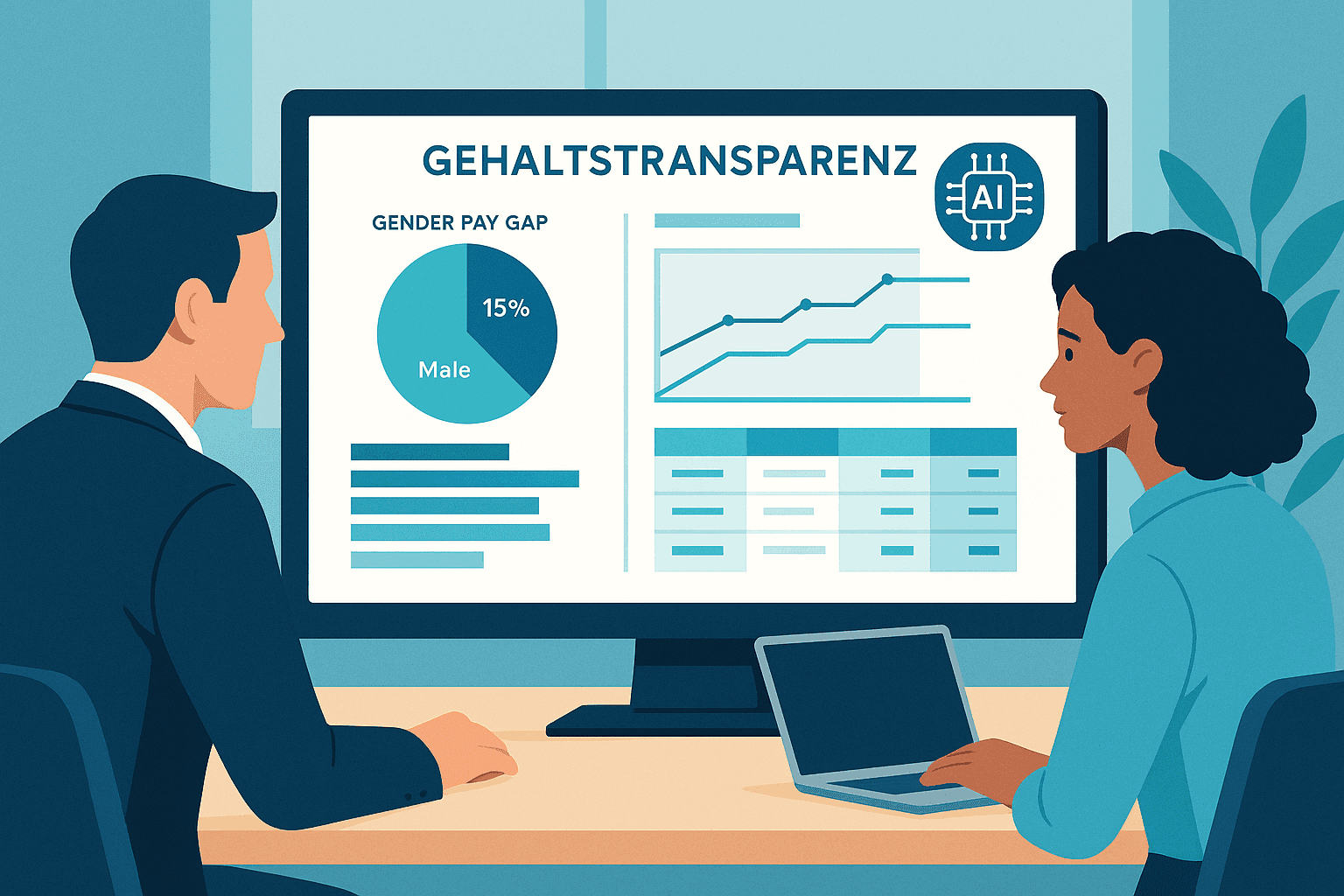
EU Salary Transparency Directive: How to Prepare Your Payroll for June 2026
Discover the best tools for implementing the EU Pay Transparency Directive – including AI solutions like project b. for fair and data-driven salary analyses.
Dec 2, 2025
·
AI
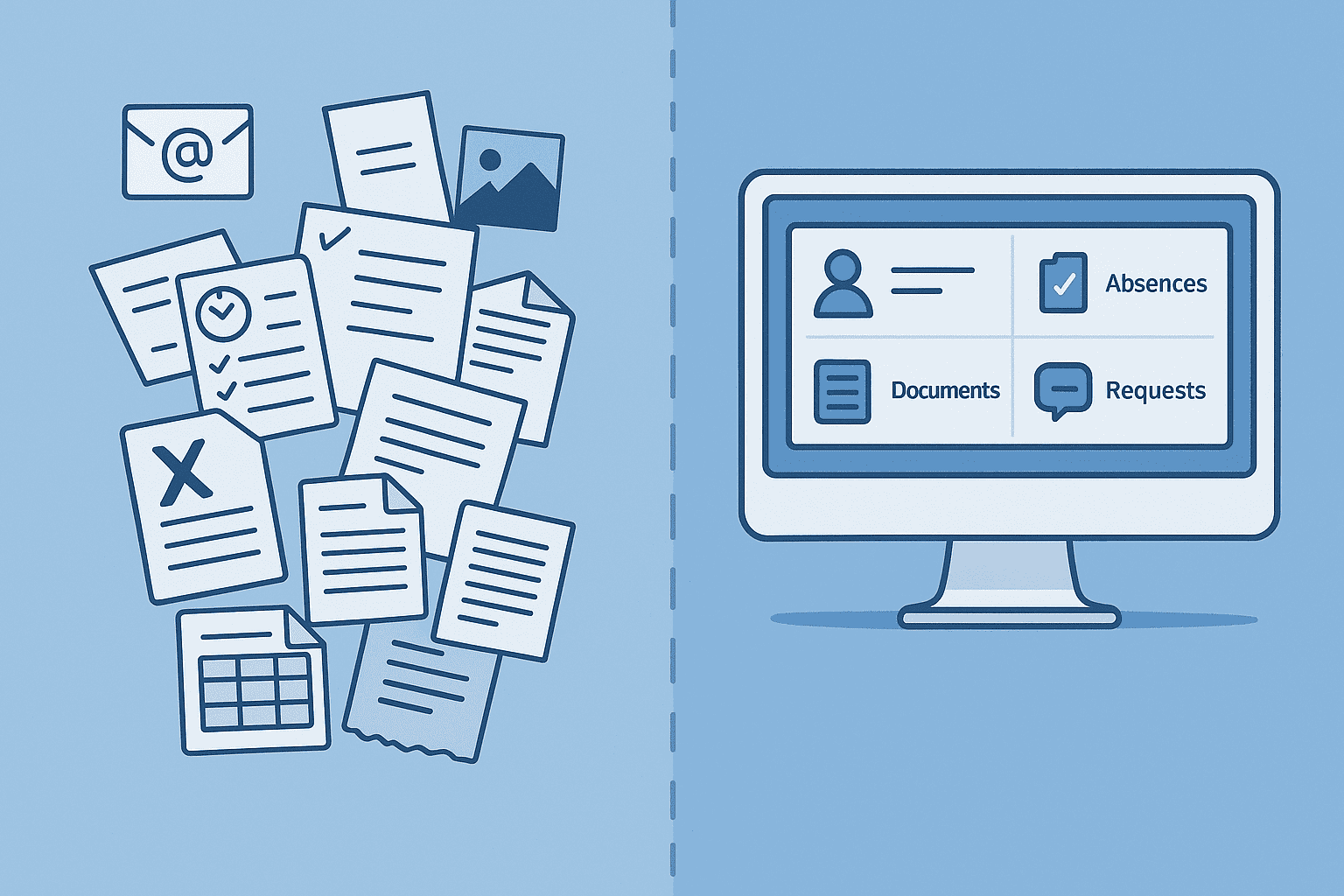
5 Reasons for Payroll Processing with project b.
Discover 5 reasons why tax consultants and payroll offices digitize their preparatory payroll accounting with project b. AI-assisted data collection, fewer queries, full DATEV integration.
Nov 27, 2025
·
AI
RPA vs. AI in Payroll: The Ultimate Technology Comparison 2026
RPA or AI in payroll accounting? The major comparison for 2026 shows advantages, costs, areas of application, and practical examples for the right automation strategy.
Nov 26, 2025
·
AI
AI in payroll processing: What will be possible in 2026 and what will not?
AI in Payroll 2026: What can artificial intelligence really achieve in payroll? Reality check with maturity assessment, practical examples, and an honest analysis of the limits. For payroll offices, tax advisors, and SMEs.

Nov 25, 2025
·
AI
5 Easy Ways to Automate Payroll in 2026
5 practical ways to automate payroll: from digital time tracking to AI-driven software. With cost-saving examples for medium-sized businesses, tax consultants, and payroll offices.
Nov 24, 2025
·
Payment
Pension flat-rate reform 2026: What employers need to adjust in their payroll software now
Major income tax reform from 2026: The retirement allowance will be recalculated. Learn how this affects net wages, payroll software, and employers.
Nov 20, 2025
·
Payment
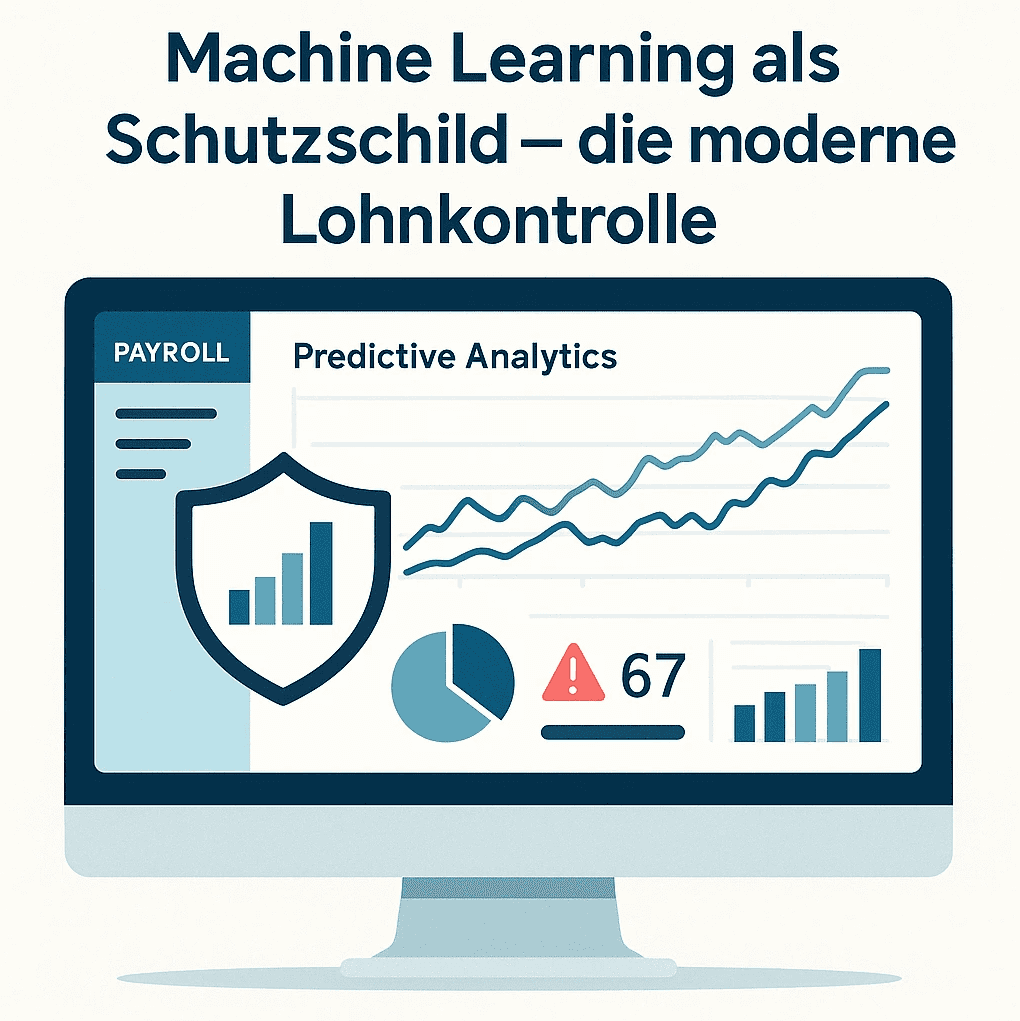
Predictive Analytics in Payroll: How Tax Advisors Avoid Costly Mistakes
Discover how predictive analytics reduces error rates in payroll, saves costs, and transforms your payroll from reactive to proactive.
Nov 18, 2025
·
Payment
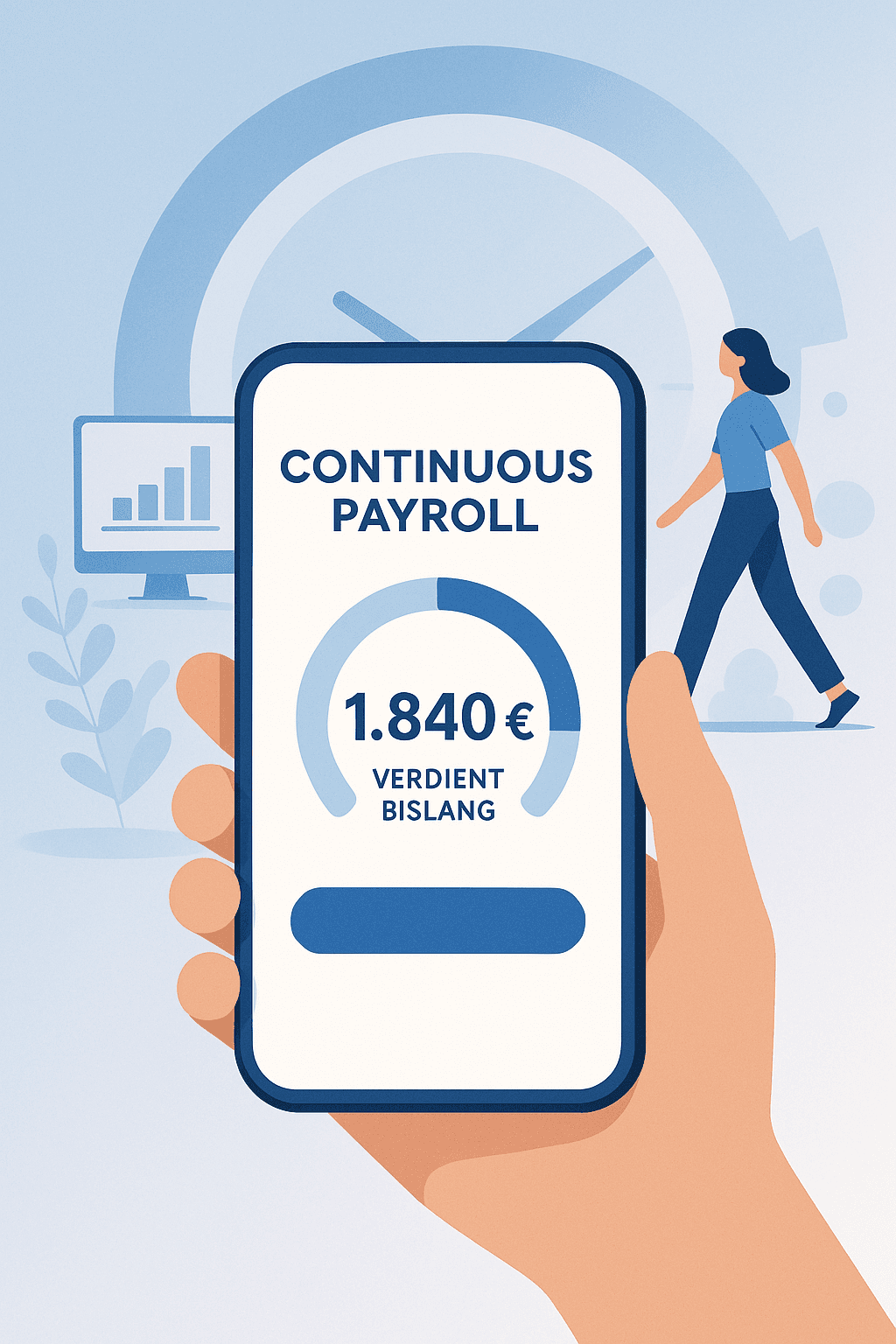
Continuous Payroll 2026: How Real-Time Payroll Processing is Replacing Monthly Payroll Statements
Continuous Payroll revolutionizes payroll processing: real-time salary data, on-demand pay, and fewer errors. This is how SMEs and HR teams benefit in 2026.
Nov 13, 2025
·
Personal
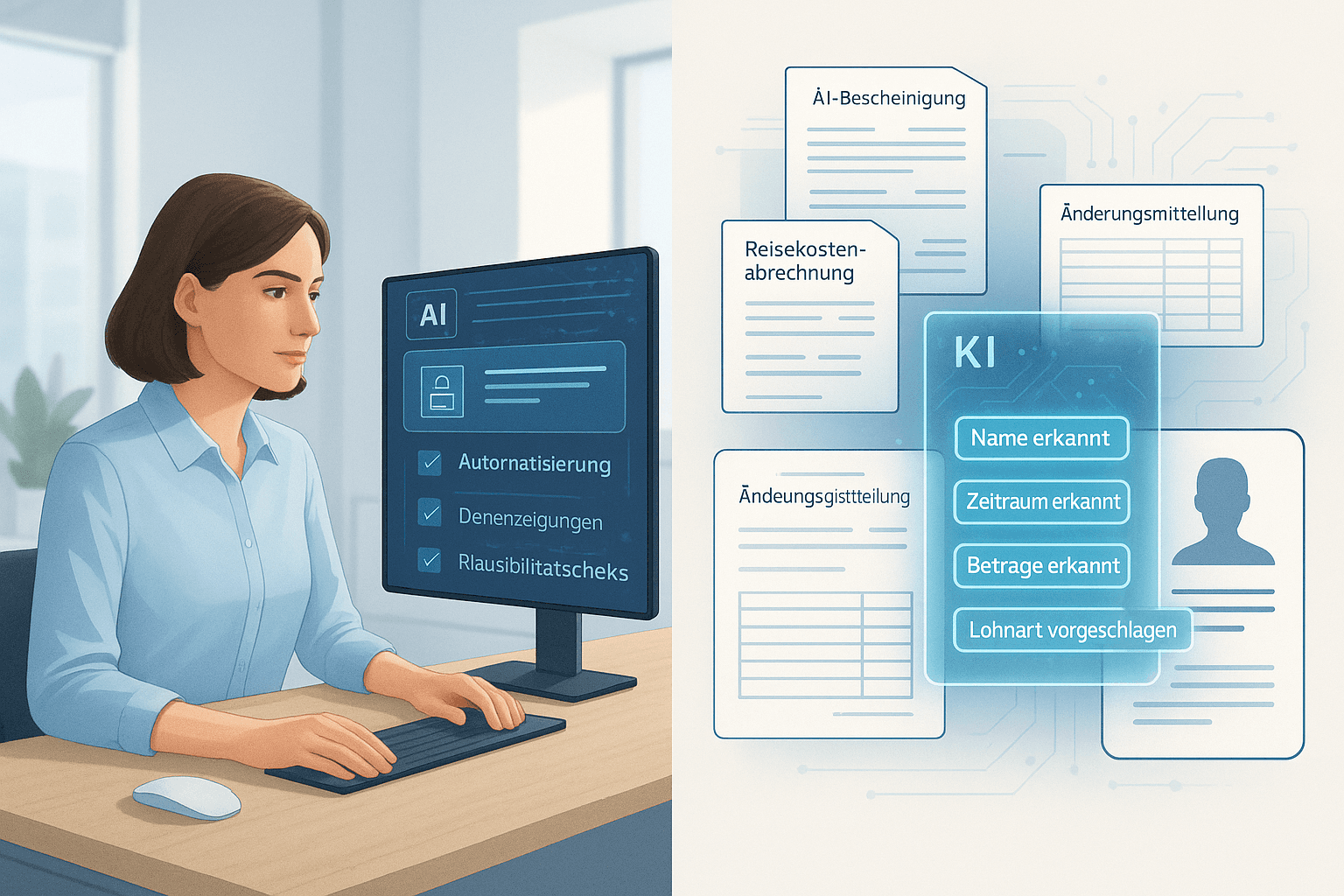
AI in Payroll Accounting: Practical Guide for Payroll Offices and Tax Advisors 2026
AI in Payroll Accounting 2026: Practical Guide for Payroll Offices with Software Comparison (project b., DATEV, Lexware), ROI Calculation and Step-by-Step Instructions.