Kosten der Lohnbuchhaltung: Inhouse vs. Outsourcing im Vergleich
Feb 6, 2026
Lohnbuchhaltung Kosten: Inhouse ab 35.000 Euro/Jahr vs. Outsourcing ab 6.000 Euro/Jahr. Break-Even-Analyse, ROI-Rechnung und Entscheidungshilfe.
Ready for payroll that finally takes the pressure off?
Leave your contact details - we will get back to you shortly.
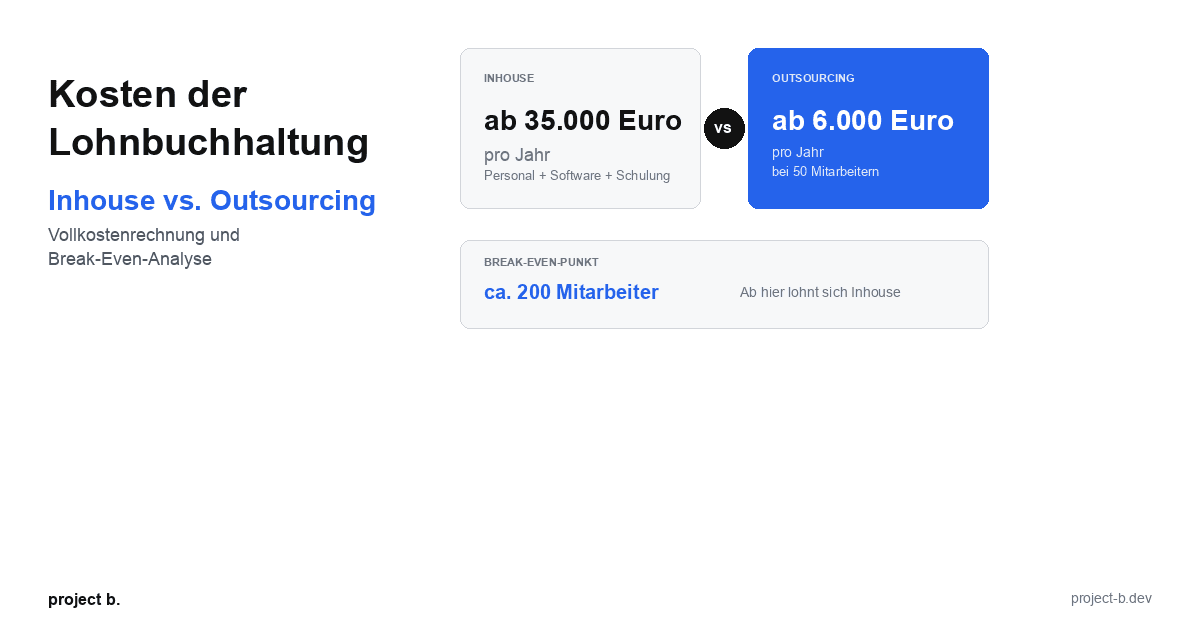
Inhouse oder auslagern? Diese Frage stellt sich jedes wachsende Unternehmen irgendwann. Die Antwort ist weniger emotional als oft diskutiert. Es geht um Zahlen, Prozesse und strategische Prioritäten.
Dieser Artikel liefert eine ehrliche Vollkostenrechnung für beide Optionen, zeigt den Break-Even-Punkt und hilft Ihnen mit einer klaren Entscheidungshilfe.
Vollkostenrechnung Inhouse
Die meisten Unternehmen unterschätzen die tatsächlichen Kosten einer internen Lohnbuchhaltung. Hier eine vollständige Aufstellung.
Personalkosten
Der größte Kostenblock. Ein Lohnbuchhalter kostet mehr als das Bruttogehalt.
Gehaltsstruktur 2026:
Position | Gehaltsspanne (brutto/Jahr) |
|---|---|
Junior Lohnbuchhalter | 36.000 bis 42.000 € |
Lohnbuchhalter mit Erfahrung | 42.000 bis 55.000 € |
Senior / Teamleitung | 55.000 bis 70.000 € |
Arbeitgebernebenkosten (ca. 21 %):
Sozialversicherung Arbeitgeberanteil: ~19,5 %
Umlagen (U1, U2, Insolvenzgeld): ~1,5 %
Beispielrechnung erfahrener Lohnbuchhalter:
Bruttogehalt: 48.000 €
Arbeitgebernebenkosten: 10.080 €
Personalkosten gesamt: 58.080 €/Jahr
Arbeitsplatzkosten
Ein Mitarbeiter braucht mehr als einen Schreibtisch.
Position | Kosten pro Jahr |
|---|---|
Bürofläche (8 m² × 15 €/m²) | 1.440 € |
Arbeitsplatzausstattung (anteilig) | 800 € |
IT-Infrastruktur (Hardware, Support) | 1.200 € |
Nebenkosten (Strom, Heizung, etc.) | 600 € |
Summe Arbeitsplatz | 4.040 € |
Softwarekosten
Lohnabrechnung erfordert spezialisierte Software.
Software | Kosten pro Jahr |
|---|---|
DATEV Lohn und Gehalt | 2.400 bis 4.800 € |
oder: Agenda Lohnabrechnung | 1.800 bis 3.600 € |
oder: Lexware Lohn | 600 bis 1.200 € |
Updates und Wartung | 300 bis 600 € |
Durchschnitt | 2.500 € |
Schulungs- und Fortbildungskosten
Das Lohnrecht ändert sich ständig. Ohne Fortbildung veraltet das Wissen.
Position | Kosten pro Jahr |
|---|---|
Fachseminare (2-3 pro Jahr) | 800 bis 1.500 € |
Fachliteratur | 200 bis 400 € |
Arbeitszeit für Fortbildung (3 Tage) | 960 € (interner Aufwand) |
Summe Fortbildung | 2.000 bis 2.900 € |
Vertretungskosten
Was passiert bei Urlaub, Krankheit oder Kündigung?
"Ich habe aber keine Zeit es zu verbessern."
Dieses Problem kennt jeder, der allein für die Lohnabrechnung verantwortlich ist. Vertretung muss organisiert werden.
Optionen und Kosten:
Lösung | Zusatzkosten |
|---|---|
Zweiter Mitarbeiter (Redundanz) | +50 % Personalkosten |
Externe Vertretung auf Abruf | 80-120 €/Stunde |
Kollegenvertretung (intern) | Produktivitätsverlust |
Konservativ gerechnet: 5 % Aufschlag auf Personalkosten für Vertretungsregelung.
Fehlerkosten
Fehler passieren. Die Frage ist, was sie kosten.
Fehlerart | Typische Kosten |
|---|---|
Korrekturabrechnung | 50-100 € Aufwand |
Verspätete SV-Meldung | 50-500 € Säumniszuschlag |
Falsche Lohnsteueranmeldung | Nachzahlung + Zinsen |
Betriebsprüfung mit Beanstandung | 1.000-10.000 € |
Bei einer internen Fehlerquote von 3-5 % summiert sich das.
Gesamtkosten Inhouse (Beispiel 50 Mitarbeiter)
Position | Kosten pro Jahr |
|---|---|
Personal (0,5 FTE) | 29.040 € |
Arbeitsplatz (anteilig) | 2.020 € |
Software | 2.500 € |
Fortbildung | 1.200 € |
Vertretung (5 %) | 1.450 € |
Fehlerkosten (geschätzt) | 1.500 € |
Gesamtkosten Inhouse | 37.710 € |
Pro Mitarbeiter/Jahr | 754 € |
Pro Mitarbeiter/Monat | 62,85 € |
Diese Zahl überrascht viele. Interne Lohnabrechnung ist teurer als gedacht.
Outsourcing-Kosten transparent aufgeschlüsselt
Die externe Alternative ist oft günstiger. Hier die vollständige Kostenstruktur.
Basiskosten pro Mitarbeiter
Servicelevel | Preis pro MA/Monat | Preis pro MA/Jahr |
|---|---|---|
Basis | 12 bis 18 € | 144 bis 216 € |
Standard | 18 bis 25 € | 216 bis 300 € |
Premium | 25 bis 35 € | 300 bis 420 € |
Einmalige Einrichtungskosten
Position | Kosten |
|---|---|
Stammdatenerfassung | 30-80 € pro Mitarbeiter |
Systemeinrichtung | 200-500 € pauschal |
Datenmigration | 100-300 € |
Typisch bei 50 MA | 2.000-4.500 € |
Diese Kosten fallen nur einmal an und werden oft auf 12 Monate verteilt.
Laufende Zusatzkosten
Leistung | Typische Kosten |
|---|---|
Ein-/Austritt | 25-50 € pro Vorgang |
Bescheinigungen | 15-30 € pro Stück |
Sonderabrechnungen | 20-40 € |
Korrektur (bei eigener Schuld) | Kostenfrei |
Optionale Kosten
Leistung | Typische Kosten |
|---|---|
Mandantenportal | 5-15 €/Monat |
Zusätzliche Auswertungen | Nach Aufwand |
Beratung bei Sonderfällen | 80-120 €/Stunde |
Betriebsprüfungsbegleitung | Nach Aufwand |
Gesamtkosten Outsourcing (Beispiel 50 Mitarbeiter)
Annahmen:
Standard-Servicelevel (20 €/MA)
4 Ein-/Austritte pro Monat (à 35 €)
Einrichtungskosten auf 12 Monate verteilt
Position | Kosten pro Jahr |
|---|---|
Basiskosten (50 × 20 € × 12) | 12.000 € |
Ein-/Austritte (48 × 35 €) | 1.680 € |
Einrichtung (anteilig) | 250 € |
Gesamtkosten Outsourcing | 13.930 € |
Pro Mitarbeiter/Jahr | 279 € |
Pro Mitarbeiter/Monat | 23,22 € |
Die Differenz zu Inhouse: 23.780 Euro pro Jahr.
Break-Even-Analyse mit Beispielrechnung
Ab welcher Größe lohnt sich welche Variante? Die Mathematik gibt eine klare Antwort.
Die Grundformel
Inhouse-Kosten = Fixkosten + (Variable Kosten × Mitarbeiteranzahl)
Outsourcing-Kosten = (Preis pro MA × Mitarbeiteranzahl) + Nebenkosten
Break-Even: Punkt, an dem beide Varianten gleich viel kosten.
Rechenbeispiel
Inhouse-Annahmen:
Fixkosten (Stelle, Software, Infrastruktur): 35.000 €/Jahr
Variable Kosten pro MA: 100 €/Jahr
Outsourcing-Annahmen:
Preis pro MA: 22 €/Monat = 264 €/Jahr
Nebenkosten pauschal: 2.000 €/Jahr
Break-Even-Berechnung:
35.000 + (100 × n) = (264 × n) + 2.000
35.000 - 2.000 = 264n - 100n
33.000 = 164n
n = 201 Mitarbeiter
Bei weniger als 201 Mitarbeitern ist Outsourcing günstiger. Darüber kann sich Inhouse lohnen, wenn die Qualität stimmt.
Break-Even nach Szenarien
Szenario | Break-Even |
|---|---|
Günstige Region, einfache Abrechnung | ca. 250 MA |
Durchschnitt | ca. 200 MA |
Teure Region, komplexe Abrechnung | ca. 150 MA |
Mit Premium-Outsourcing | ca. 300 MA |
Fazit: Für die große Mehrheit der Unternehmen (unter 200 Mitarbeiter) ist Outsourcing wirtschaftlicher.
Opportunitätskosten: Was kostet Ihre Zeit?
Die reine Kostenrechnung ignoriert einen wichtigen Faktor: Was könnten Sie mit der Zeit anfangen, die Sie sparen?
Zeit, die Lohnabrechnung kostet
Selbst bei externer Abrechnung bleibt Aufwand:
Aufgabe | Zeit pro Monat (intern) | Zeit pro Monat (extern) |
|---|---|---|
Daten sammeln und aufbereiten | 8 Stunden | 3 Stunden |
Kommunikation mit Mitarbeitern | 4 Stunden | 4 Stunden |
Prüfung und Freigabe | 2 Stunden | 1 Stunde |
Rückfragen klären | 4 Stunden | 1 Stunde |
Sonderfälle bearbeiten | 4 Stunden | 0,5 Stunden |
Gesamt (50 MA) | 22 Stunden | 9,5 Stunden |
Zeitersparnis durch Outsourcing: 12,5 Stunden pro Monat
Was ist diese Zeit wert?
"Ich bin der Geschäftsführer (von dem Lohnbüro, 45k Abrechnungen). Ich sehe wie immer die gleichen Anfragen reinkommen und wir hier extrem Kapazitäten sparen könnten."
Wenn ein Geschäftsführer oder HR-Leiter diese Zeit für strategische Aufgaben nutzen kann, ist der Wert erheblich.
Rechenbeispiel:
Zeitersparnis: 12,5 Stunden/Monat = 150 Stunden/Jahr
Interner Stundensatz (Vollkosten): 60 €
Wert der Zeitersparnis: 9.000 €/Jahr
Das ist zusätzlich zur direkten Kostenersparnis.
Fokus aufs Kerngeschäft
Jede Stunde, die nicht für Administration draufgeht, kann für Wertschöpfung genutzt werden:
Kundenakquise
Produktentwicklung
Mitarbeiterführung
Strategische Planung
Diese Opportunitätskosten sind schwer zu beziffern, aber real.
ROI-Betrachtung über 3 Jahre
Eine langfristige Perspektive zeigt den wahren Wert der Entscheidung.
Szenario: 50 Mitarbeiter, Wechsel zu Outsourcing
Jahr 1:
Position | Kosten |
|---|---|
Outsourcing-Kosten | 13.930 € |
Wechselkosten (einmalig) | 3.000 € |
Ersparnis vs. Inhouse | 37.710 € - 16.930 € = 20.780 € |
Jahr 2:
Position | Kosten |
|---|---|
Outsourcing-Kosten (+3 % Inflation) | 14.348 € |
Ersparnis vs. Inhouse (+3 %) | 38.841 € - 14.348 € = 24.493 € |
Jahr 3:
Position | Kosten |
|---|---|
Outsourcing-Kosten (+3 %) | 14.778 € |
Ersparnis vs. Inhouse (+3 %) | 40.006 € - 14.778 € = 25.228 € |
3-Jahres-Bilanz:
Gesamtersparnis: 70.501 €
Abzüglich Wechselkosten: 67.501 €
Durchschnittliche Jahresersparnis: 22.500 €
ROI-Formel
ROI = (Ersparnis - Investition) / Investition × 100
Für Jahr 1:
ROI = (20.780 - 3.000) / 3.000 × 100 = 593 %
Die Investition in den Wechsel amortisiert sich bereits im ersten Jahr mehrfach.
Risikofaktoren
Die Rechnung hat Unsicherheiten:
Upside-Risiken (Ersparnis könnte höher sein):
Geringere Fehlerkosten
Mehr Zeitersparnis als angenommen
Bessere Skalierbarkeit bei Wachstum
Downside-Risiken (Ersparnis könnte geringer sein):
Qualitätsprobleme beim Dienstleister
Höhere Kommunikationskosten als erwartet
Versteckte Zusatzkosten
Eine konservative Schätzung sollte 20 % Puffer einplanen.
Entscheidungshilfe: Wann was sinnvoll ist
Die Zahlen sind klar. Aber die Entscheidung hat auch qualitative Aspekte.
Outsourcing ist die bessere Wahl, wenn:
1. Sie unter 200 Mitarbeitern haben
Die Kostenrechnung spricht eindeutig für Outsourcing. Nur bei besonderen Umständen (extremer Datenschutz, sehr spezifische Anforderungen) ist Inhouse sinnvoll.
2. Ihr Kerngeschäft nicht Lohnabrechnung ist
Warum Ressourcen in eine Tätigkeit stecken, die andere besser können?
"Wir haben aktuell keine Kapazität für neue Mandanten und müssen sogar ablehnen."
Selbst spezialisierte Lohnbüros kämpfen mit Kapazitäten. Für Sie als Nicht-Spezialist gilt das erst recht.
3. Sie wachsen wollen
Outsourcing skaliert ohne proportional mehr Aufwand. 50 oder 100 Mitarbeiter, der Unterschied ist nur der Preis pro Kopf.
4. Sie Fachkräftemangel spüren
Gute Lohnbuchhalter sind schwer zu finden. Ein Dienstleister hat das Problem gelöst.
5. Sie Vertretungsprobleme haben
Was passiert, wenn Ihr Lohnbuchhalter krank wird oder kündigt? Beim Dienstleister: nichts. Alles läuft weiter.
Inhouse kann sinnvoll sein, wenn:
1. Sie über 200 bis 250 Mitarbeitern haben
Ab dieser Größe kann sich eine interne Abteilung rechnen, wenn sie effizient arbeitet.
2. Sie sehr spezifische Anforderungen haben
Manche Branchen oder Tarifverträge sind so speziell, dass internes Know-how unverzichtbar ist.
3. Datenschutz oberste Priorität hat
In manchen Branchen (Rüstung, kritische Infrastruktur) kann externe Datenverarbeitung problematisch sein.
4. Sie bereits ein funktionierendes Team haben
Wenn Ihre Lohnbuchhaltung gut läuft und die Mitarbeiter zufrieden sind, ist ein Wechsel riskant.
5. Integration mit anderen Prozessen wichtig ist
Wenn Lohnabrechnung eng mit HR-Prozessen verzahnt ist, kann interne Kontrolle Vorteile haben.
Die Hybrid-Option
Viele Unternehmen wählen einen Mittelweg:
Software + Service: Sie nutzen eine Plattform, aber ein Dienstleister übernimmt die eigentliche Arbeit
Teilauslagerung: Routine extern, Sonderfälle intern
Co-Sourcing: Zusammenarbeit mit einem spezialisierten Partner
Diese Modelle kombinieren Vorteile beider Welten.
project b.: Die moderne Alternative
Wenn Sie sich für Outsourcing entscheiden, sollten Sie project b. kennenlernen.
Kosteneffizienz durch Technologie
Die KI-Assistentin RITA automatisiert repetitive Aufgaben. Das senkt die Kosten für alle Beteiligten.
"Wir sehen die meisten Effizienzgewinne mit euch, wenn der Kunde weiterhin machen kann, was er will, aber wir bekommen die Daten einheitlich."
Mehr dazu im Artikel Lohnabrechnung Kosten pro Mitarbeiter: Was Sie 2026 zahlen.
Nahtlose Integration
project b. arbeitet als Vorsystem für DATEV. Keine Systemwechsel, keine Medienbrüche.
Erfahren Sie mehr im Artikel Was kostet eine Lohnabrechnung beim Steuerberater?.
Flexibilität
Keine Mindestvertragslaufzeit
Transparente Preise
Setup in 30 Minuten
Sicherheit
ISO 27001:2022 zertifiziert
DSGVO-konform
Server in Deutschland
Weitere Informationen auf unserer Seite Payroll Outsourcing.
Fazit: Die Zahlen sprechen für sich
Die Entscheidung zwischen Inhouse und Outsourcing ist keine Glaubensfrage. Es ist eine Rechenaufgabe.
Die Kernerkenntnisse:
Inhouse-Kosten werden unterschätzt
Vollkosten liegen bei 50 bis 80 Euro pro Mitarbeiter, nicht bei den oft angenommenen 20 bis 30 Euro.Break-Even liegt bei 200+ Mitarbeitern
Für die große Mehrheit der Unternehmen ist Outsourcing wirtschaftlicher.Opportunitätskosten einrechnen
Zeit, die nicht für Administration draufgeht, kann für Wertschöpfung genutzt werden.ROI ist schnell positiv
Die Wechselkosten amortisieren sich typischerweise im ersten Jahr.Qualitative Faktoren zählen auch
Skalierbarkeit, Expertise und Vertretungssicherheit haben einen Wert.
Treffen Sie die Entscheidung auf Basis von Zahlen, nicht von Gewohnheit. Ihr Unternehmen wird davon profitieren.
Einen umfassenden Leitfaden zum Outsourcing finden Sie im Artikel Lohnabrechnung auslagern: Der komplette Leitfaden für 2026.
Ab welcher Unternehmensgröße lohnt sich eine eigene Lohnbuchhaltung?
Ab etwa 200 Mitarbeitern kann sich eine interne Lohnbuchhaltung rechnen. Darunter ist Outsourcing in der Regel kostengünstiger, da die Fixkosten auf zu wenige Abrechnungen verteilt werden.
Wie hoch sind die Wechselkosten zu einem externen Anbieter?
Die Wechselkosten liegen typischerweise bei 2.000 bis 5.000 Euro für ein Unternehmen mit 50 Mitarbeitern. Sie setzen sich aus Datenmigration, Einrichtung und Parallelbetrieb zusammen.
Kann ich jederzeit wieder zu Inhouse wechseln?
Ja. Die meisten Outsourcing-Verträge haben kurze Kündigungsfristen. Ein Rückwechsel erfordert jedoch Neuaufbau von Know-how und Infrastruktur, was Zeit und Geld kostet.
Finn R.
Further articles
Feb 9, 2026
·
Payment
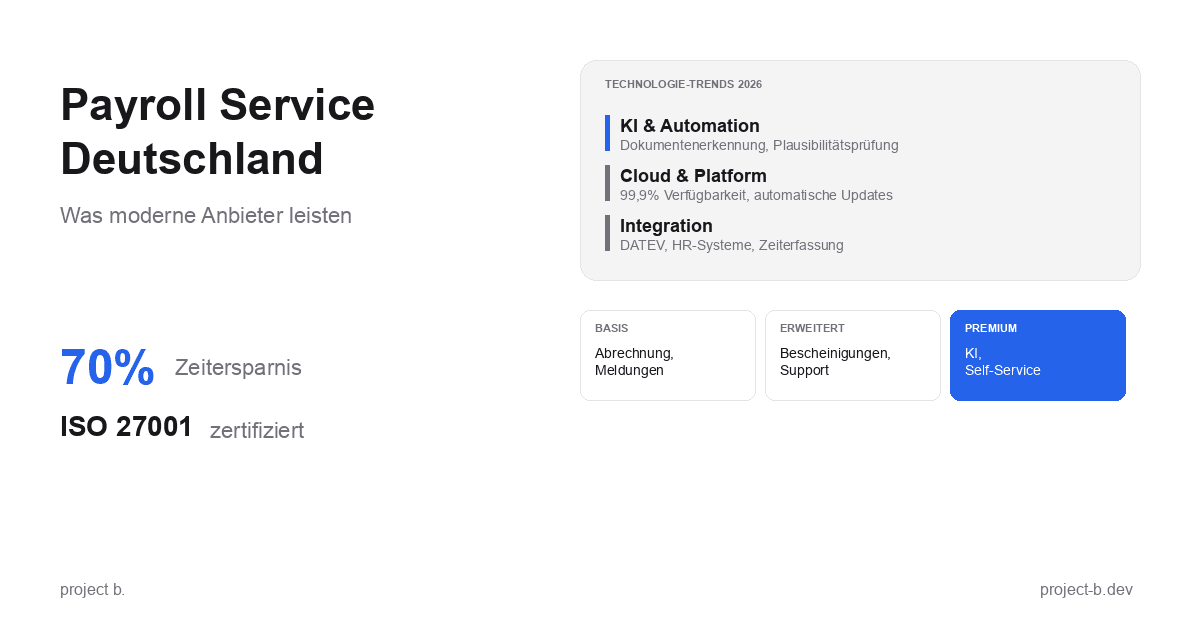
Payroll Service Deutschland: Was moderne Anbieter leisten
Payroll Service in Deutschland gesucht? Erfahren Sie, was moderne Anbieter leisten, welche Technologien sie nutzen und worauf Sie bei der Auswahl achten sollten.
Feb 11, 2026
·
Outsourcing
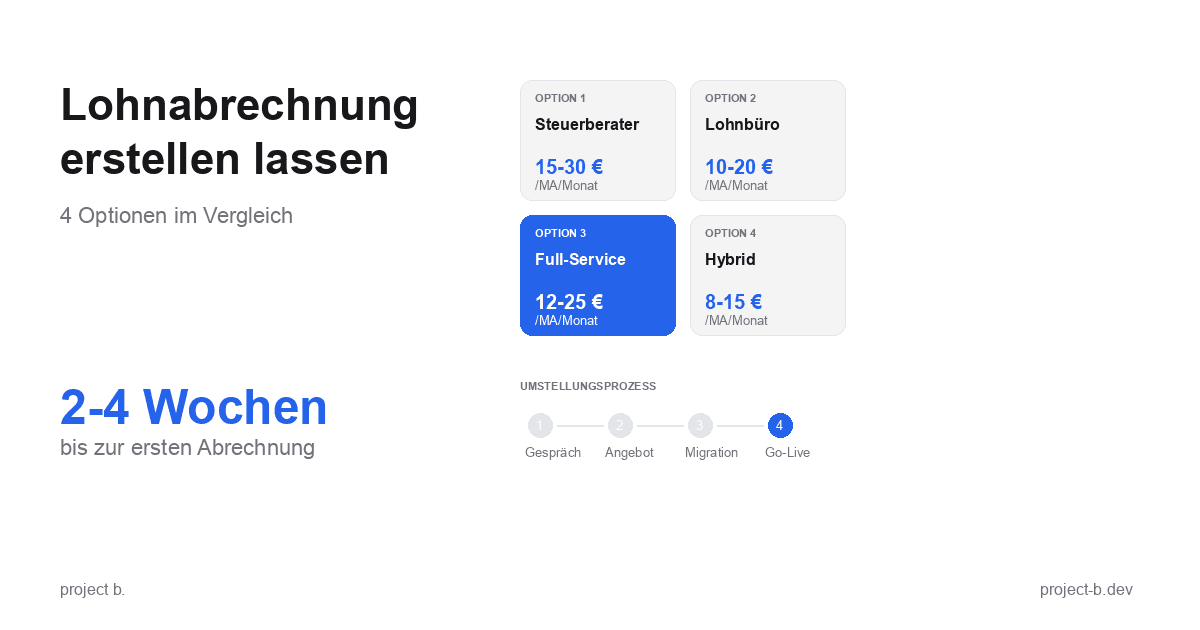
Lohnabrechnung erstellen lassen: Ihre Optionen im Vergleich
Lohnabrechnung erstellen lassen statt selbst kämpfen? Erfahren Sie, welche Optionen Sie haben, was es kostet und wie schnell Sie starten können.
Feb 9, 2026
·
Outsourcing
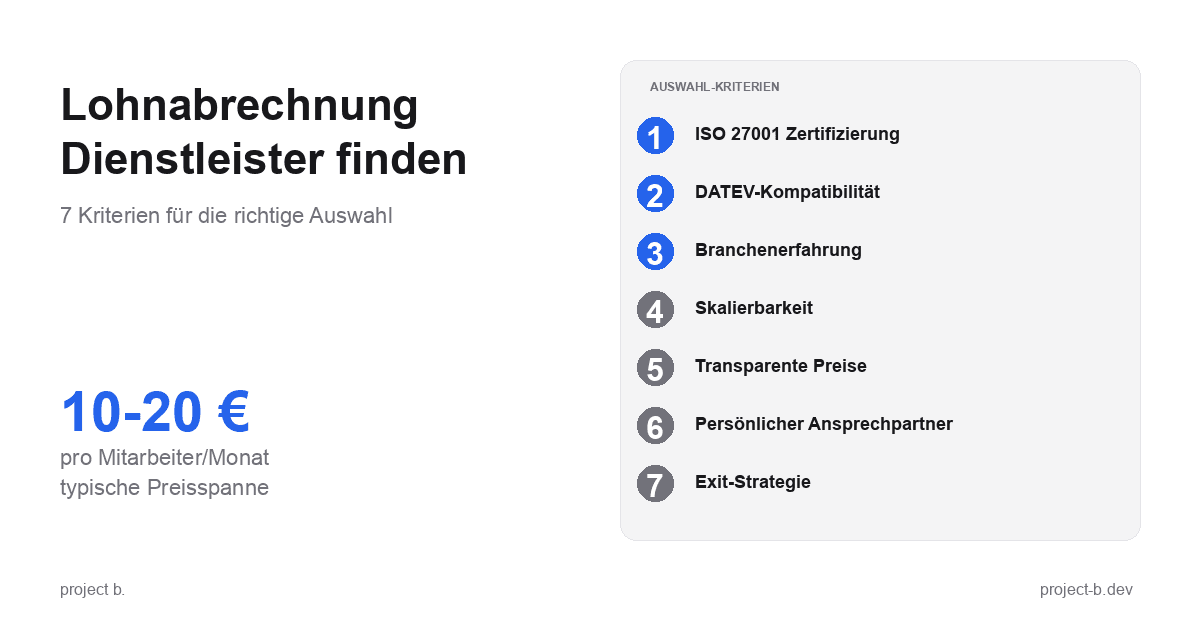
Lohnabrechnung Dienstleister: So finden Sie den richtigen Partner
Lohnabrechnung Dienstleister gesucht? 7 Kriterien für die Auswahl, Preisvergleich und Checkliste fürs Erstgespräch. Finden Sie den Partner, der zu Ihnen passt.
Feb 4, 2026
·
Outsourcing
Lohnabrechnung Kosten pro Mitarbeiter: Was Sie 2026 zahlen
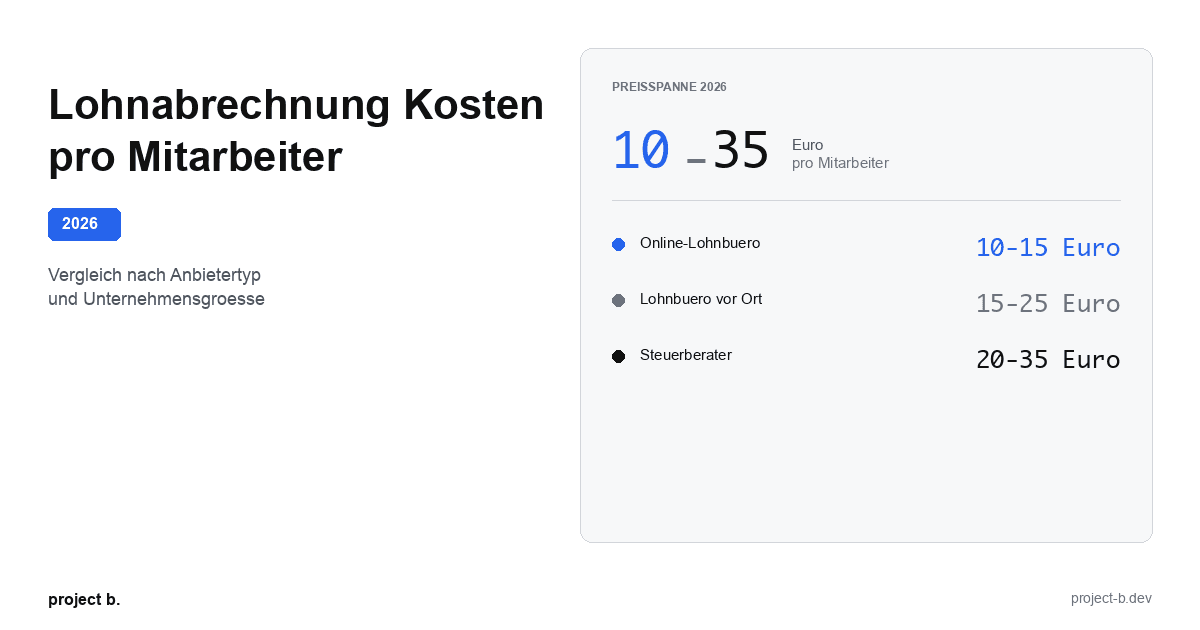
Lohnabrechnung Kosten 2026: 10-35 Euro pro Mitarbeiter je nach Anbieter. Vergleich nach Unternehmensgroesse, Branche und versteckte Kosten aufgedeckt.
Feb 2, 2026
·
Outsourcing
Was kostet eine Lohnabrechnung beim Steuerberater?
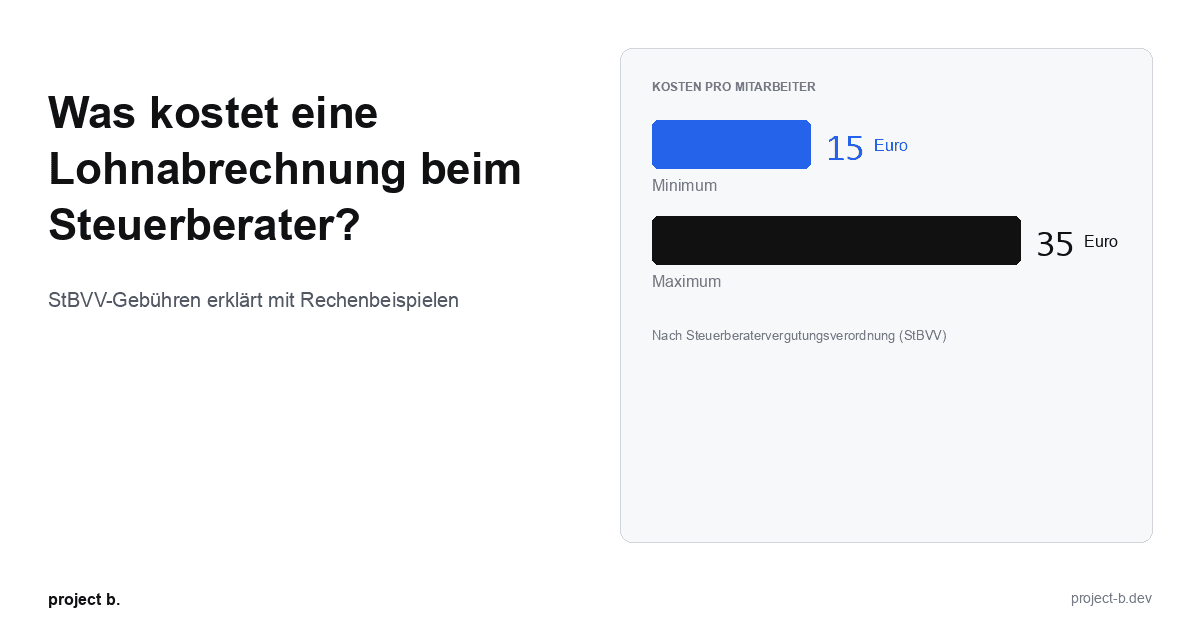
Lohnabrechnung beim Steuerberater: Kosten von 15-35 € pro Mitarbeiter. StBVV-Gebühren erklärt, Preisvergleich und Rechenbeispiele für 10, 50, 100 Mitarbeiter.

Jan 30, 2026
·
Outsourcing
Outsource payroll accounting: When is the right time?
Outsourcing payroll: 7 clear signs that now is the right time. Including break-even analysis and DATEV integration check.
Jan 28, 2026
·
Outsourcing
Outsourcing payroll accounting: The complete guide for 2026
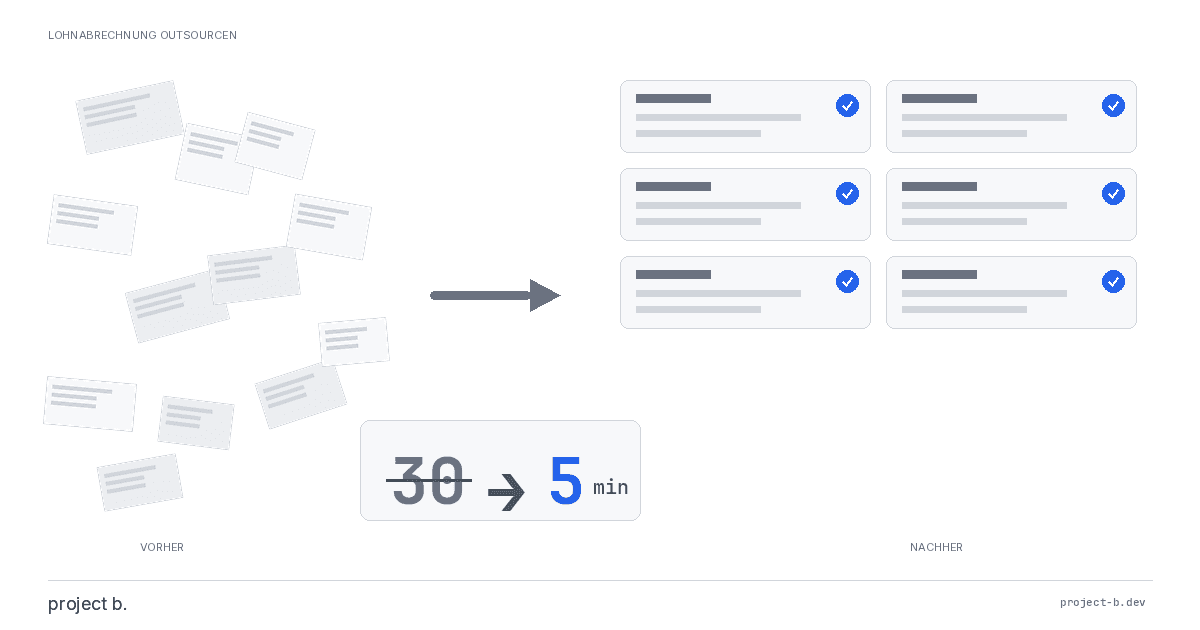
Outsource payroll processing 2026: Costs from €10 per employee, step-by-step guide and GDPR checklist. This is how to make the transition without risk.
Jan 26, 2026
·
Outsourcing
Outsourcing payroll: Costs, benefits, and providers at a glance
Outsource payroll accounting from €10 per employee. Learn about the benefits of outsourcing, its costs, and how to find the right provider.
Jan 22, 2026
·
AI
Client portal vs. Email chaos: What modern payroll processing is all about
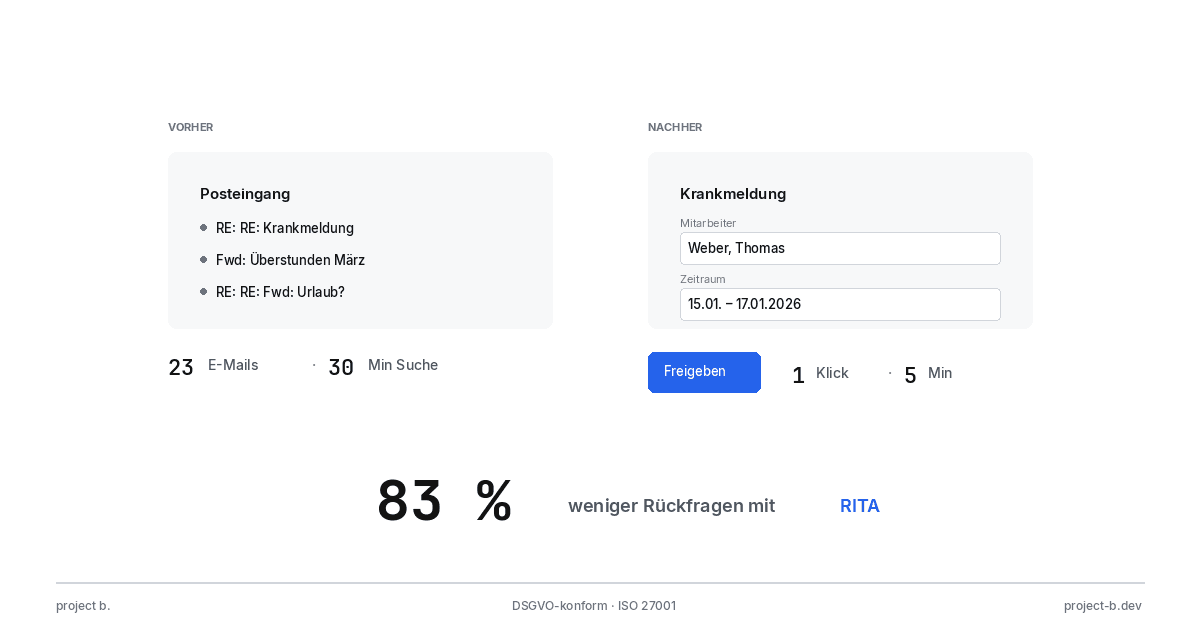
Payroll statements by email pose a GDPR risk. With the project b. Portal and RITA, you save 1,400 hours/year. This is how secure data exchange works.
Jan 20, 2026
·
AI
From Excel to the Cockpit: How Payroll Offices Will Make the Leap into Digitalization in 2026
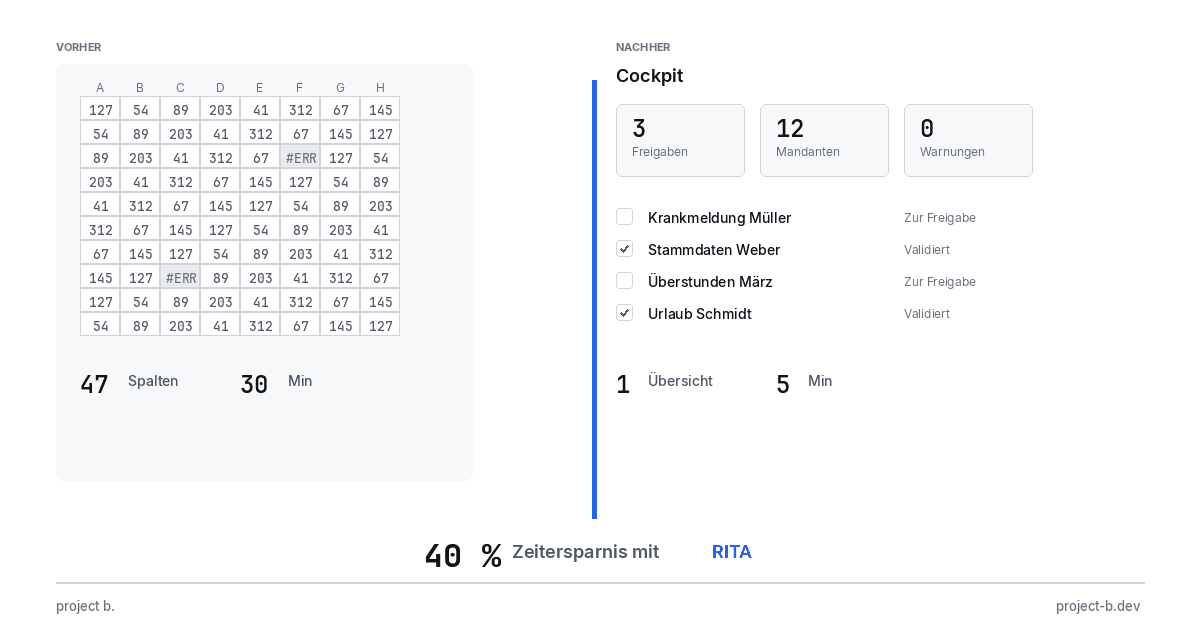
Digital payroll instead of Excel: With RITA and the project b. cockpit, payroll offices save 40% time without switching to DATEV. Practical guide with checklist.
Jan 15, 2026
·
Personal
ELStAM Procedure 2026: This is how the new private health insurance notification for employers works
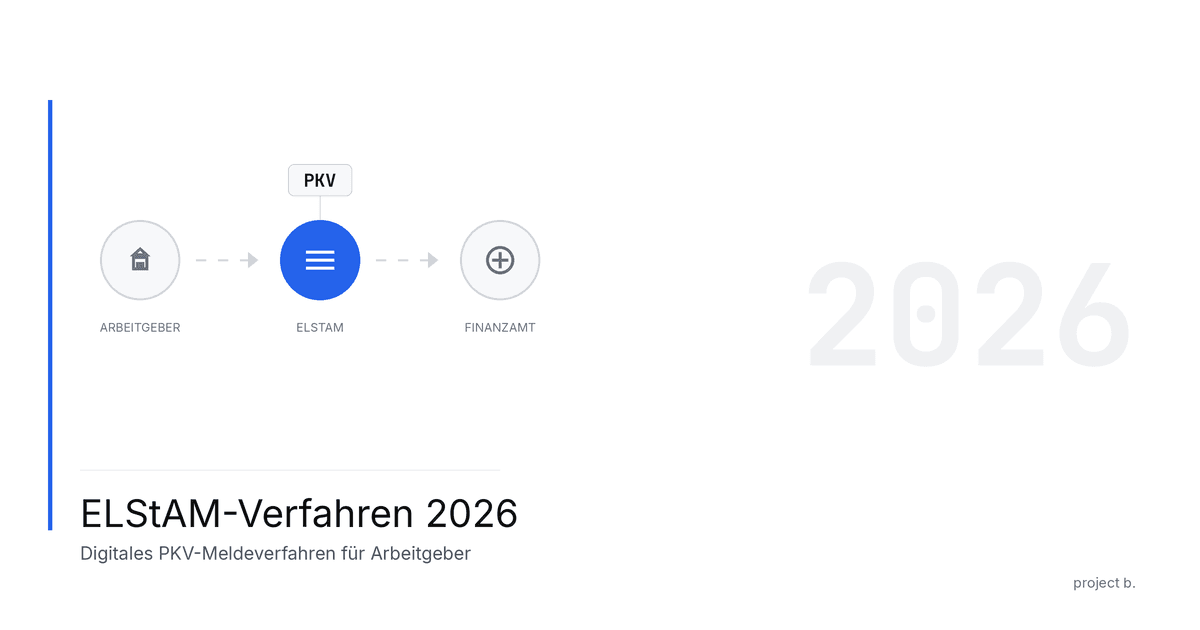
From 2026, employers will report private health insurance contributions digitally via the ELStAM procedure. Find out which systems are affected and how you can prepare now.
Jan 14, 2026
·
AI
Active pension 2026: What payroll offices and HR departments need to prepare now
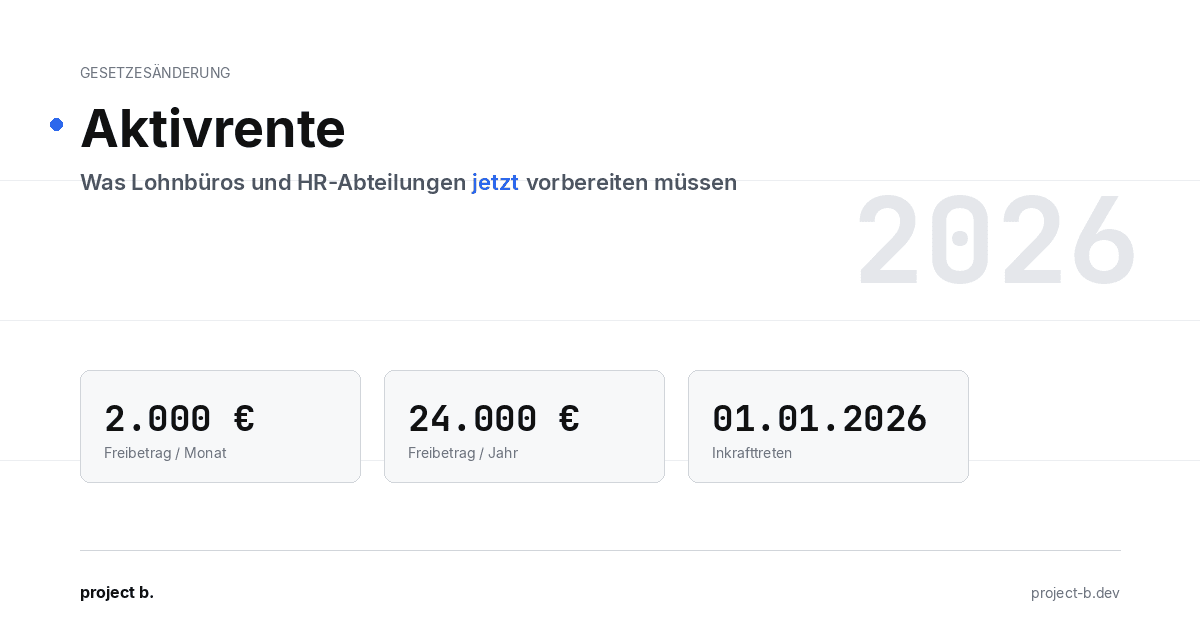
Pension from January 2026: Up to €2,000 tax allowance for retirees. Learn about the changes in payroll processes and how AI facilitates implementation.
Jan 13, 2026
·
AI
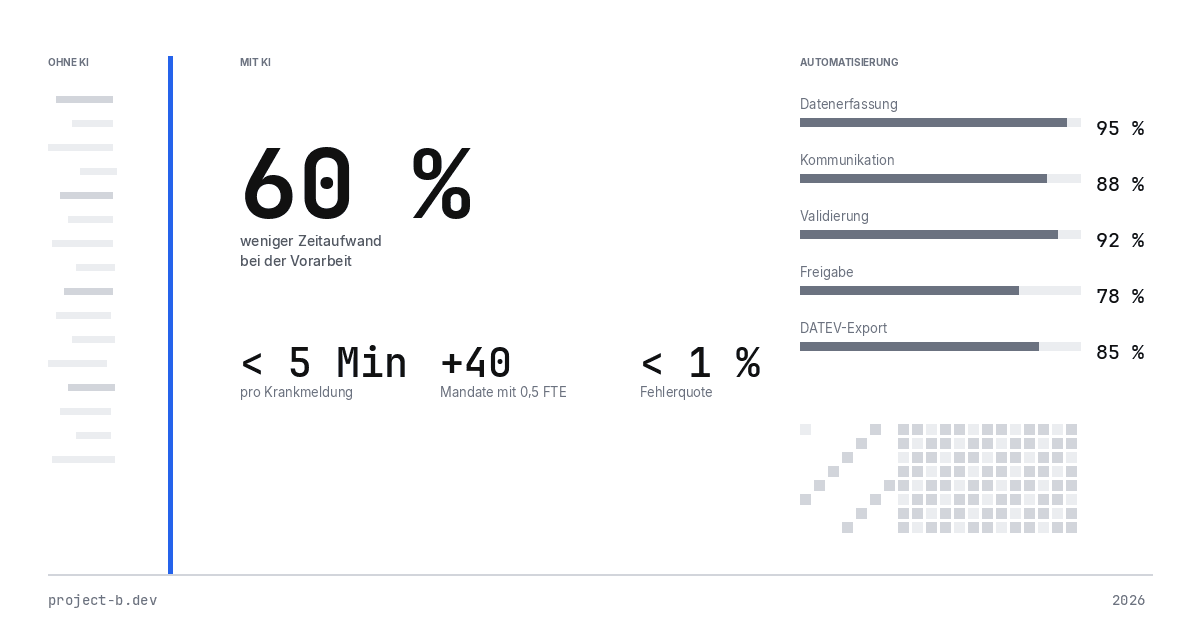
AI-Powered Payroll Software: How Tax Advisors Will Save Time in 2026
AI payroll accounting for tax consultants: Learn how project b. reduces manual work by 80% with RITA and helps combat the skilled labor shortage.
Jan 8, 2026
·
Payment
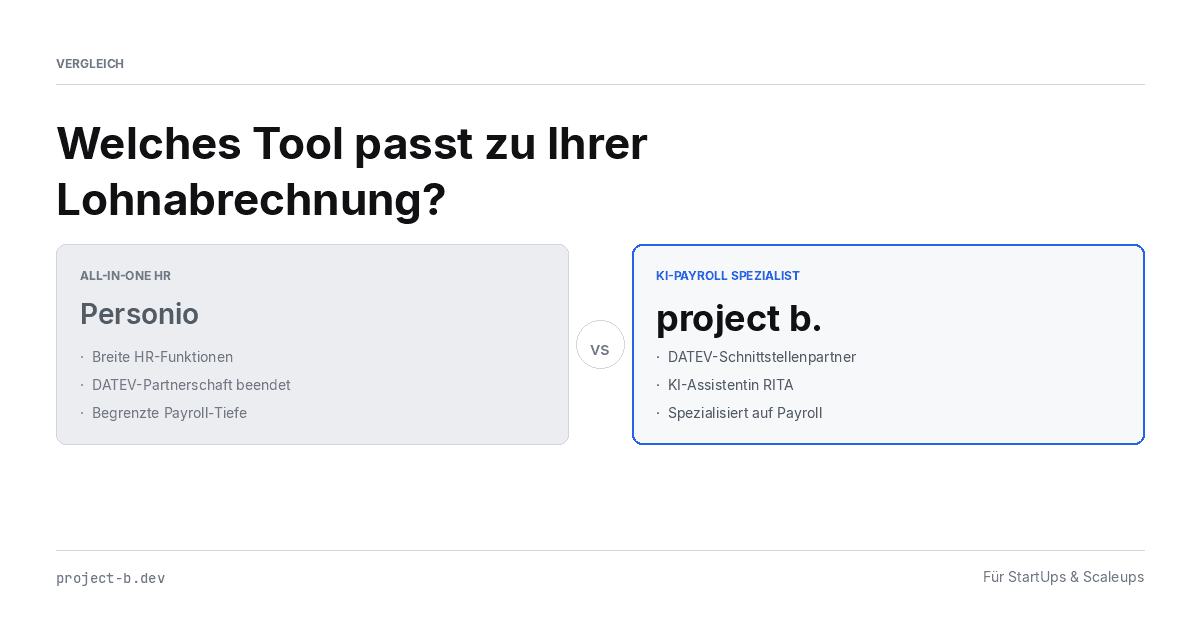
Personio vs. project b.: Which tool really fits your payroll?
Personio or project b.? Comparison for StartUps & Scaleups: DATEV integration, AI automation, costs. Why specialized payroll tools are gaining traction.
Jan 4, 2026
·
Payment
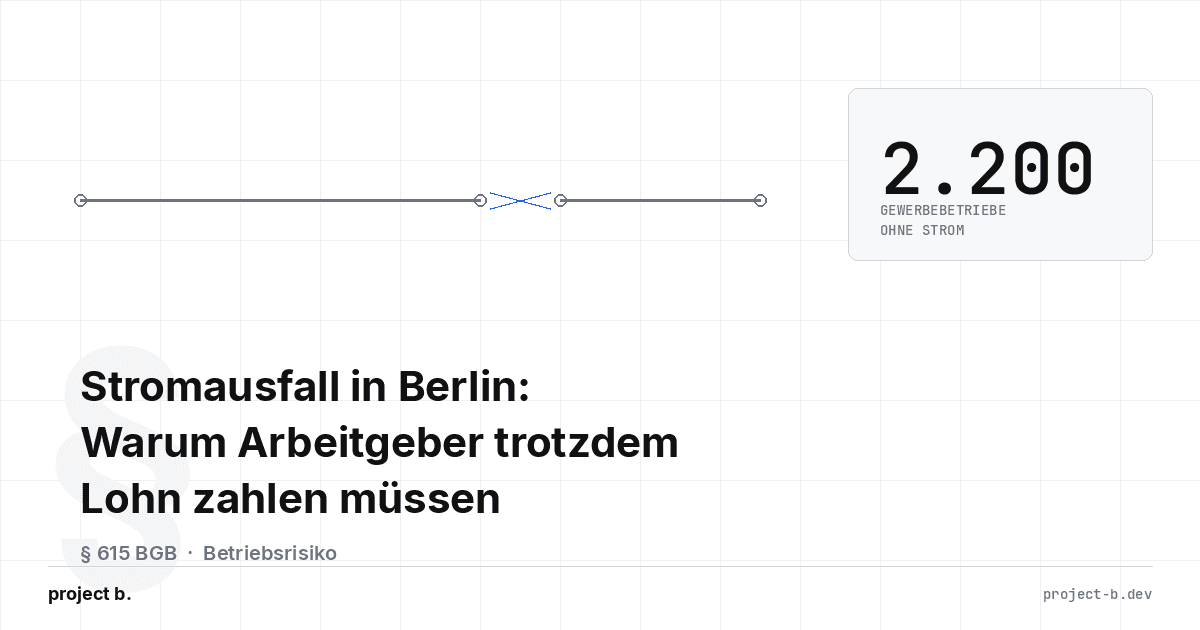
Power outage in Berlin: Why employers still have to pay wages
Power outage Berlin 2026: 2,200 businesses affected. Find out why employers must still pay wages according to § 615 BGB - and what applies to payroll.
Jan 5, 2026
·
AI
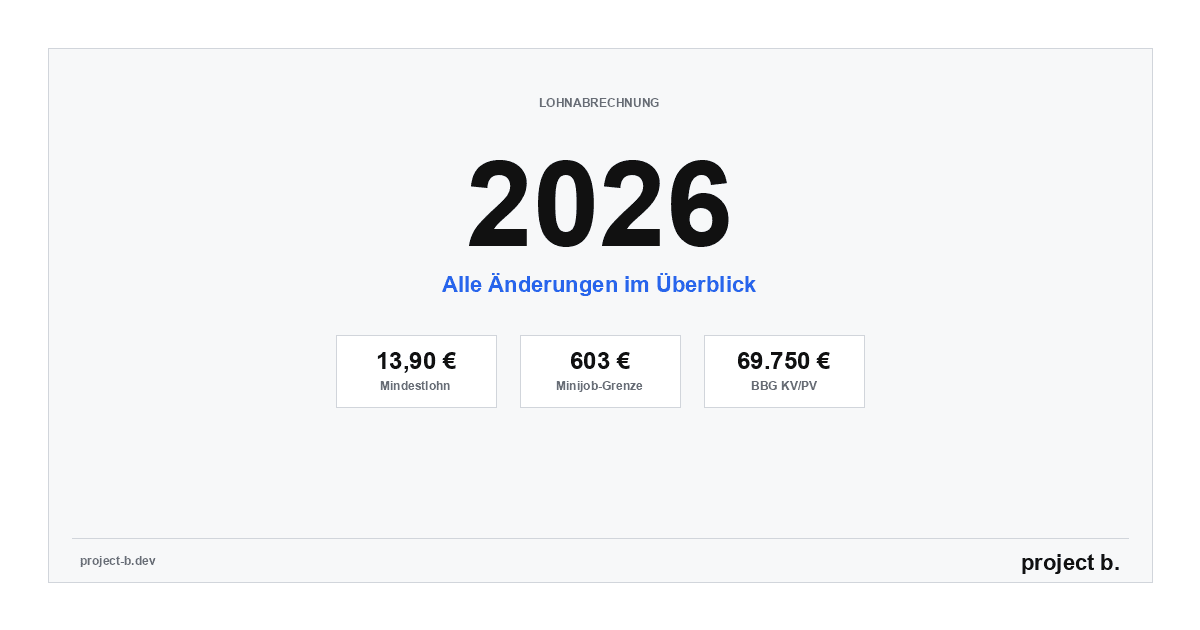
Payroll 2026: All Changes at a Glance (with AI Automation)
Minimum wage €13.90, mini-job limit €603, new contribution assessment ceilings: An overview of all changes for payroll in 2026. Learn how AI automatically implements these updates.

Dec 31, 2025
·
AI
AI in Payroll: Hype or Help?
AI in payroll processing: What is behind it? A guide for anyone who wants to understand the topic before making a decision.

Dec 29, 2025
·
AI
Payroll without professionals? This is how AI will help in 2026
AI in payroll: 70% less routine work, 0.1% error rate. This is how companies are solving the skilled labor shortage in payroll accounting in 2026.

Dec 26, 2025
·
AI
This is how you use AI in payroll.
Enough with manual data collection: This is how AI supports payroll accounting in case of sickness notifications, master data, and billing - without loss of control.

Dec 22, 2025
·
AI
How an AI layer works in payroll.
Digital payroll, but manual data entry? An AI layer closes the gap between employees, HR, and DATEV & Co.
Dec 17, 2025
·
AI
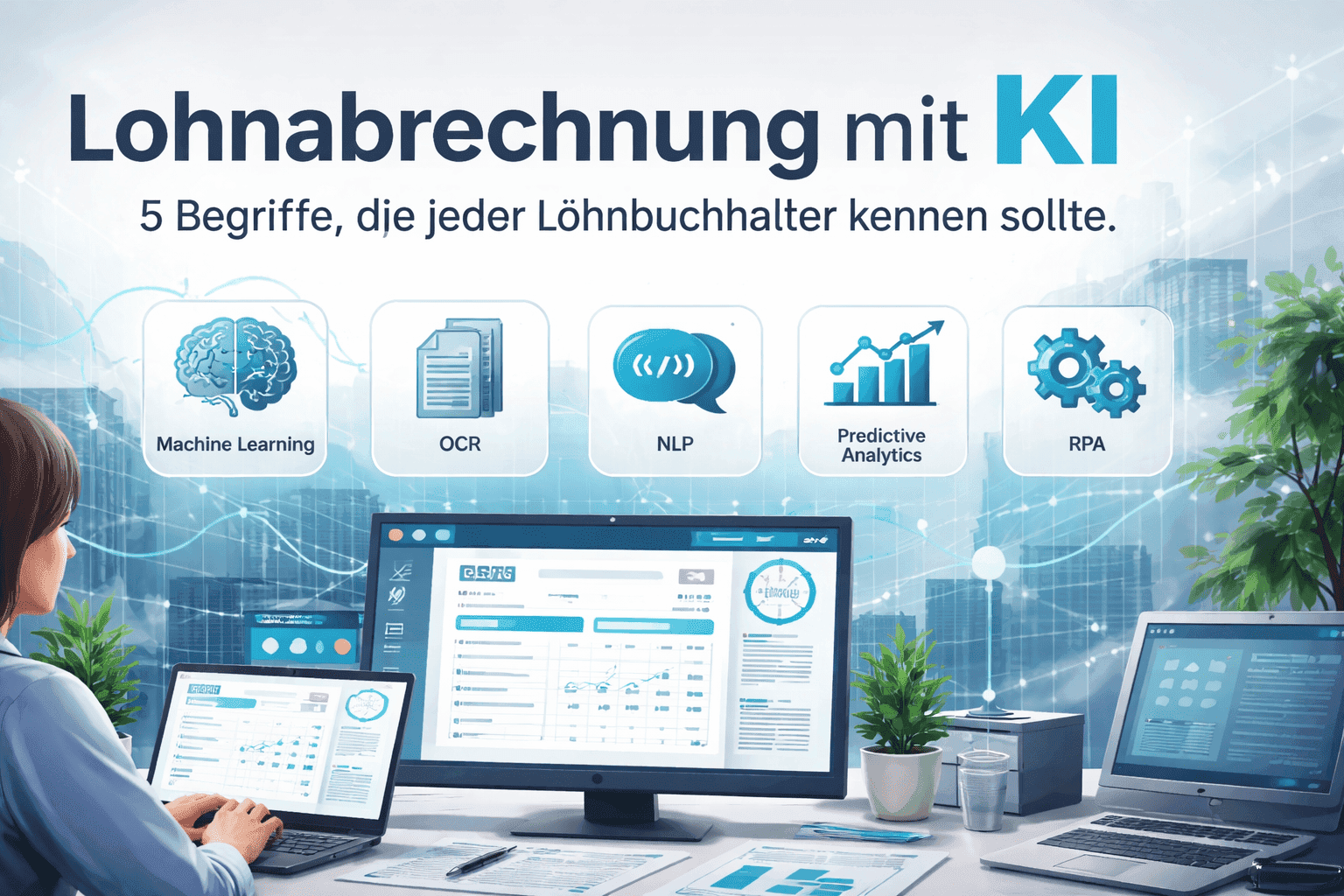
Payroll accounting with AI: 5 terms that every payroll clerk should know
Payroll processing explained clearly with AI: These 5 key AI terms payroll accountants should know to automate processes, reduce errors, and work more efficiently.

Dec 10, 2025
·
AI
How companies automate payroll accounting with Rita
Learn how Rita from project b. has automated the preliminary payroll accounting. From data collection to DATEV integration: This is how payroll agencies and tax consultants save up to 70% time.

Dec 8, 2025
·
AI
AI Software for Payroll Accounting: The Ultimate Selection Guide
Discover the ultimate selection guide for AI software in payroll. Compare AI tools and find the best payroll software for your business.
Dec 2, 2025
·
AI
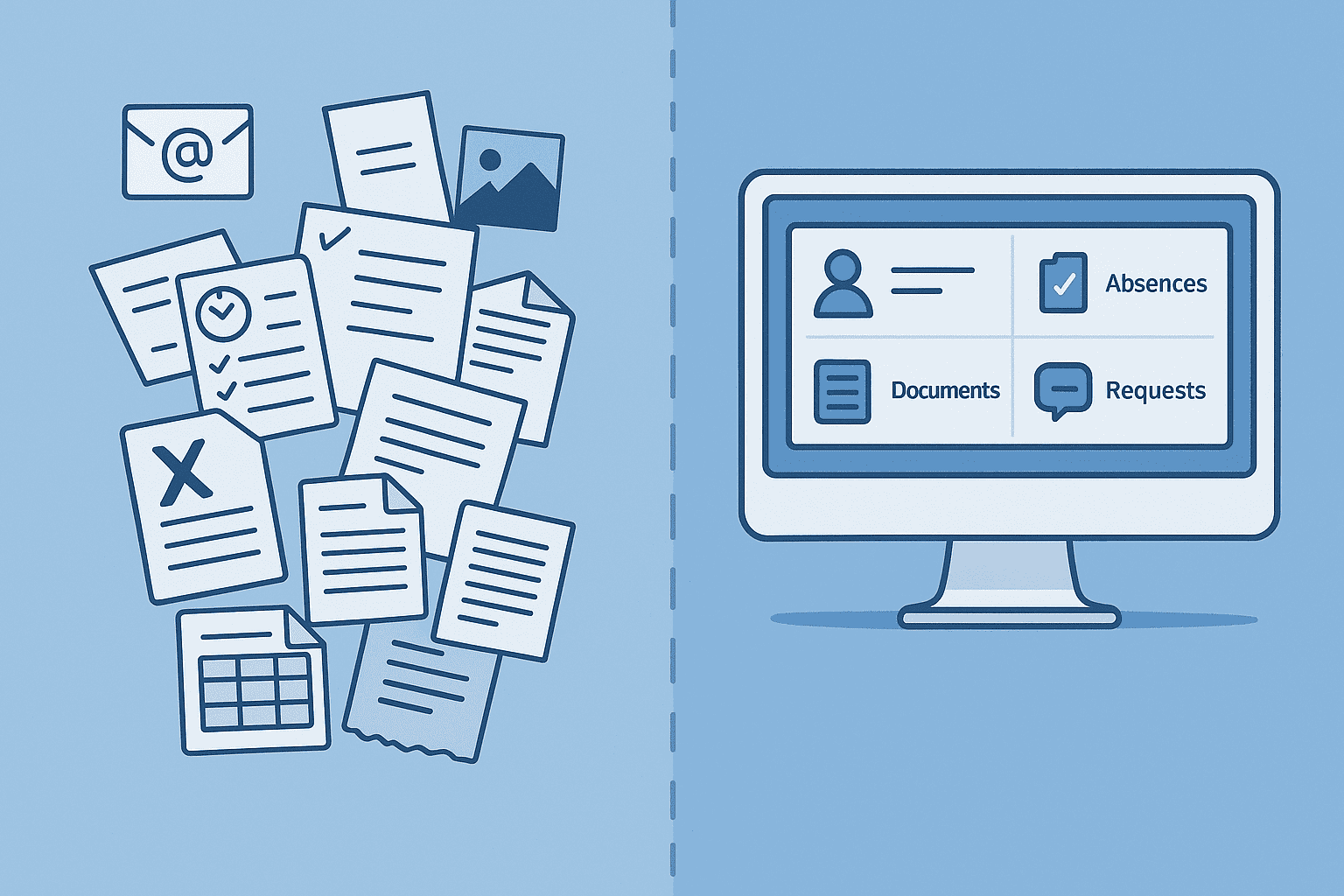
5 Reasons for Payroll Processing with project b.
Discover 5 reasons why tax consultants and payroll offices digitize their preparatory payroll accounting with project b. AI-assisted data collection, fewer queries, full DATEV integration.

Dec 5, 2025
·
AI
10 processes in payroll that AI is already handling today
Discover 10 payroll processes that AI has already automated: from master data validation to compliance monitoring. Save up to 94% time on digital payroll.

Dec 3, 2025
·
Payment
EU Salary Transparency Directive: How to Prepare Your Payroll for June 2026
Discover the best tools for implementing the EU Pay Transparency Directive – including AI solutions like project b. for fair and data-driven salary analyses.

Dec 4, 2025
·
Payment
The story of DATEV and how it became an unshakable power in German accounting.
DATEV is more than software – it is the infrastructural foundation of German accounting. The text shows how a cooperative of tax advisors became the central backbone of accounting and payroll through regulatory entanglement, standardization, and decades of trust-building. At the same time, it explains why this very structure is hindering innovation today: closed data architectures, high switching costs, and a system built for stability rather than AI-based automation. A look at how the past and present shape digital progress.

Nov 25, 2025
·
AI
5 Easy Ways to Automate Payroll in 2026
5 practical ways to automate payroll: from digital time tracking to AI-driven software. With cost-saving examples for medium-sized businesses, tax consultants, and payroll offices.

Nov 26, 2025
·
AI
AI in payroll processing: What will be possible in 2026 and what will not?
AI in Payroll 2026: What can artificial intelligence really achieve in payroll? Reality check with maturity assessment, practical examples, and an honest analysis of the limits. For payroll offices, tax advisors, and SMEs.
Nov 27, 2025
·
AI
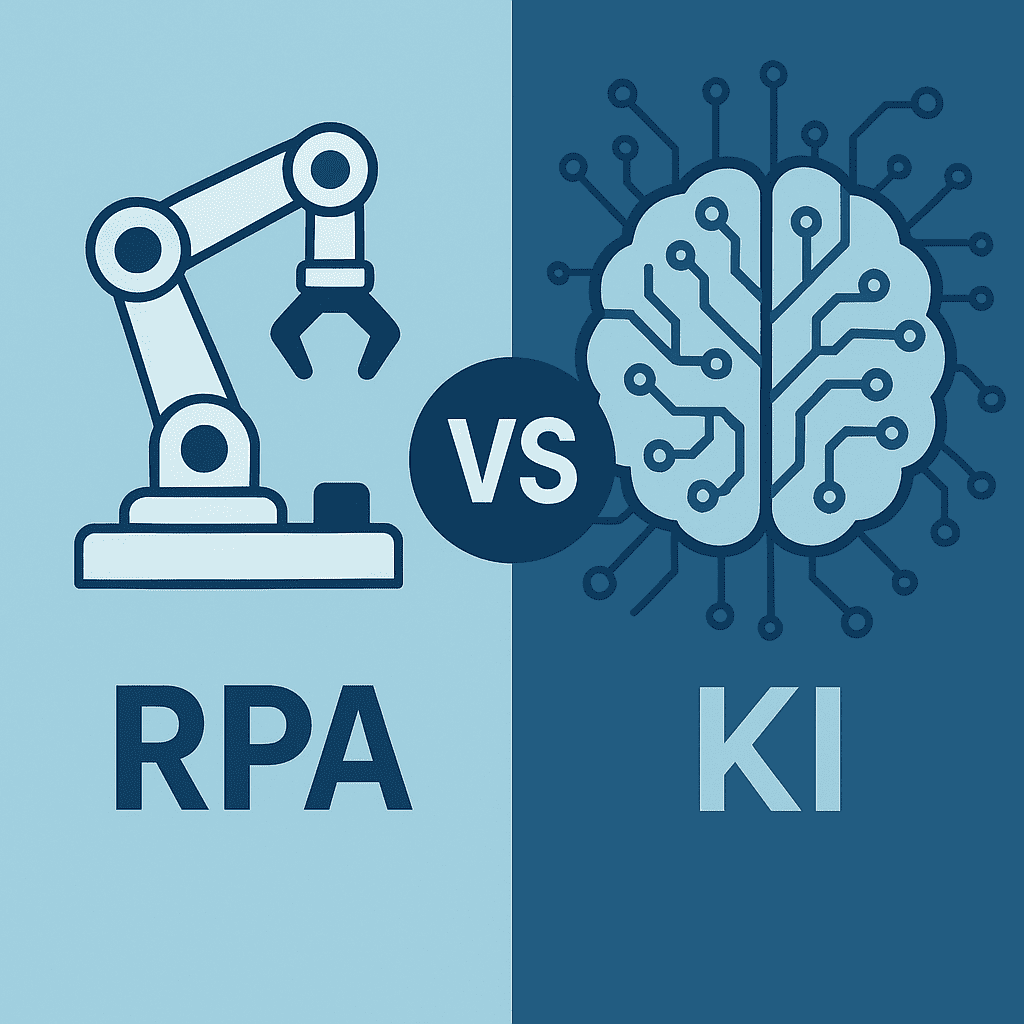
RPA vs. AI in Payroll: The Ultimate Technology Comparison 2026
RPA or AI in payroll accounting? The major comparison for 2026 shows advantages, costs, areas of application, and practical examples for the right automation strategy.

Nov 24, 2025
·
Payment
Pension flat-rate reform 2026: What employers need to adjust in their payroll software now
Major income tax reform from 2026: The retirement allowance will be recalculated. Learn how this affects net wages, payroll software, and employers.
Nov 18, 2025
·
Payment
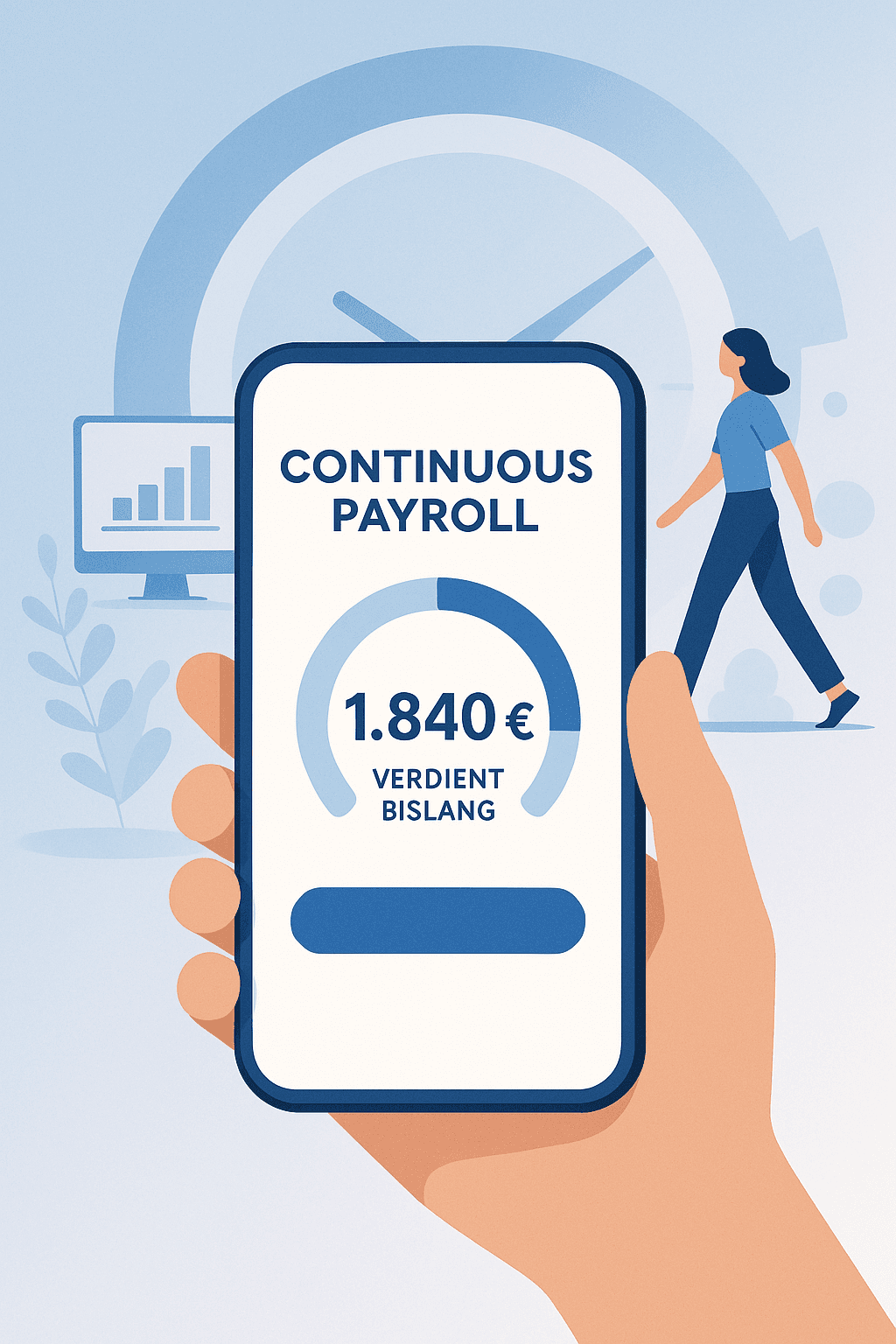
Continuous Payroll 2026: How Real-Time Payroll Processing is Replacing Monthly Payroll Statements
Continuous Payroll revolutionizes payroll processing: real-time salary data, on-demand pay, and fewer errors. This is how SMEs and HR teams benefit in 2026.
Nov 20, 2025
·
Payment
Predictive Analytics in Payroll: How Tax Advisors Avoid Costly Mistakes
Discover how predictive analytics reduces error rates in payroll, saves costs, and transforms your payroll from reactive to proactive.
Nov 13, 2025
·
Personal
AI in Payroll Accounting: Practical Guide for Payroll Offices and Tax Advisors 2026
AI in Payroll Accounting 2026: Practical Guide for Payroll Offices with Software Comparison (project b., DATEV, Lexware), ROI Calculation and Step-by-Step Instructions.